Loading...
12. Miniatures and wars
12. Miniatures and wars
00:00
00:00
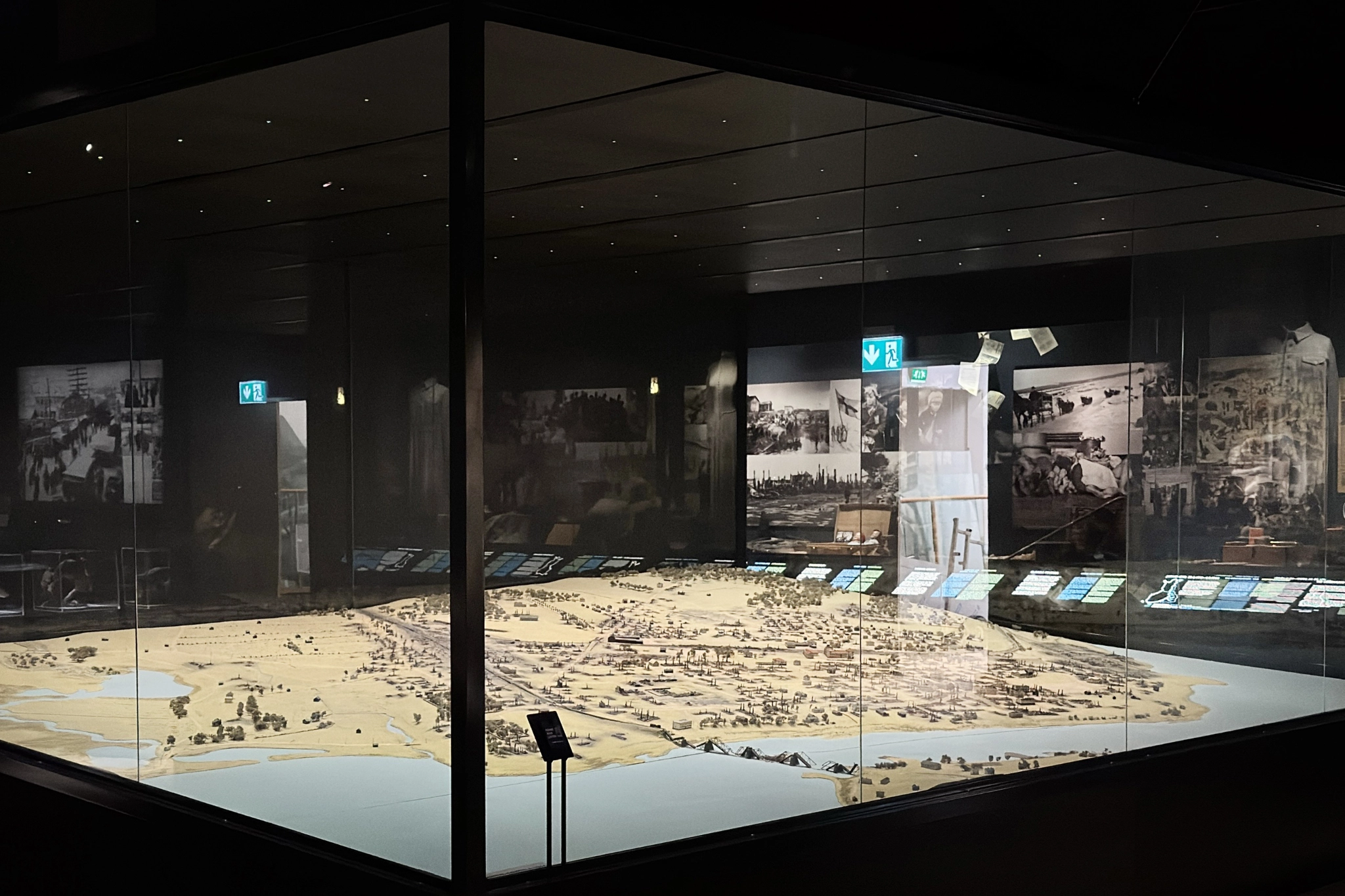
Rovaniemi has long been an important center of the Lapland region's administration, businesses and tourism. Through the miniature models on display, you can see what Rovaniemi looked like before and after the Second World War.
In 1939, Rovaniemi, with a population of about 6,600, had a hospital, a church, a railway station, schools and banks, among other things. The center was built in an urban style and there were many beautiful houses and gardens representing functionalism. Roads led to Rovaniemi from seven different directions.
The mood of the city changed dramatically as a result of World War II. The miniature model of Rovaniemi, which was destroyed at the end of the war tells a tragic tale: only a few dozen buildings built before the war remained standing, in fact, Rovaniemi was one of the most devastated population centers in Europe during the Second World War, suffering widespread demolition on a scale comparable to Dresden in Germany.
By the end of the War, Rovaniemi had been all but destroyed by the German army. Between 1941 and 1944, more than 220,000 German soldiers lived in Lapland and Northern Finland, due to the brotherhood of arms between Finland and Germany. The civil administration was in the hands of the Finns, and the area was not occupied. The Germans were in the area as an invited foreign military force. During the coexistence that brought internationalism to the province, several friendships were also formed between Finns and Germans.
When the armistice was signed on September 4, 1944, the Soviet Union demanded that the German troops be removed from Finland within two weeks, if necessary by force. When retreating to the northern Arctic Ocean, the German army used scorched earth tactics and destroyed a huge number of villages, bridges, boats, telephone lines and roads in Lapland.
The reconstruction of Rovaniemi took almost ten years. Soon after the destruction, a new site plan was drawn up for the city. The new site plan, designed by Finnish architect Alvar Aalto and completed in 1945, is known as Reindeer antler pattern, because from a bird’s eye view, it resembles a reindeer's head complete with antlers.
Finland became independent after the First World War in 1917. However, during the Second World War, Finland and the Lapland region were the battlefields of several heavy wars and the country's independence was at stake.
In the 3,5-month long winter war in 1939-1940, Finland was attacked by the Soviet Union without a declaration of war. Their aim was to conquer Finland in three weeks. The Finnish population of less than four million was left to fight alone against about 160 million Russians without any military help from foreign powers. Sympathies were on the side of small Finland and the country received humanitarian aid from other countries. More than 8,000 Swedish volunteers also arrived to strengthen the defence of Lapland. The defenders were helped by the bitter cold at times, skiing skills and good terrain knowledge. The Red Army lost an estimated 400,000 men, wounded or killed. Finland lost 70,000. As a result of the war, Finland lost about 10% of its land area, but retained its independence.
In 1940, Germany planned an attack on the Soviet Union and needed Finland,
as a transit connection for their troops in northern Norway. In the spring of 1941, Finland joined the coalition fighting alongside Germany. For Finland, the so-called continuation war began on June 25, 1941. The German Lapland Army, later the 20th Mountain Army, established at the beginning of 1942, under the leadership of Colonel General Dietl, was responsible for the Northern Finland military area.
After a long period of positional warfare, at the beginning of June 1944, the Soviet Union began a large-scale attack, which was focussed on the Finnish defence located in southeastern Finland, the Karelian Isthmus. Finland was forced to withdraw from the war despite the harsh peace terms, and an armistice was signed on September 4, 1944.
The war in Lapland started when, as a result of these peace terms, the German troops in Finland were ordered to be evicted from Finland within two weeks. The war that broke out between the former brothers-in-arms and the retreat to the northern Arctic Ocean eventually lasted more than 7 months.
At the Paris Peace Treaties in 1947, Finland's new borders were confirmed. The refugees and evacuees from the lost areas had to be resettled in new residential areas. During the Second World War, an estimated 70,000–80,000 children were sent, without their parents, from Finland to Sweden, Norway and Denmark to live with other families or in children's homes. A large number of children sent to neighboring countries during the war returned home after the war, but it is estimated that for various reasons, as many as 15,000 children never came back home.
You can learn more about the wars and the touching stories related to them in the exhibition.
Theme
