Loading...
13. Forestry work and log floating
13. Forestry work and log floating
00:00
00:00
The forest industry has long been one of the cornerstones of the Finnish economy. This is easy to understand when you look at the Finnish landscape: almost 75% of our land area is forest.
The industrial processing of forest resources into lumber and paper products began in Finland at the end of the 19th century.
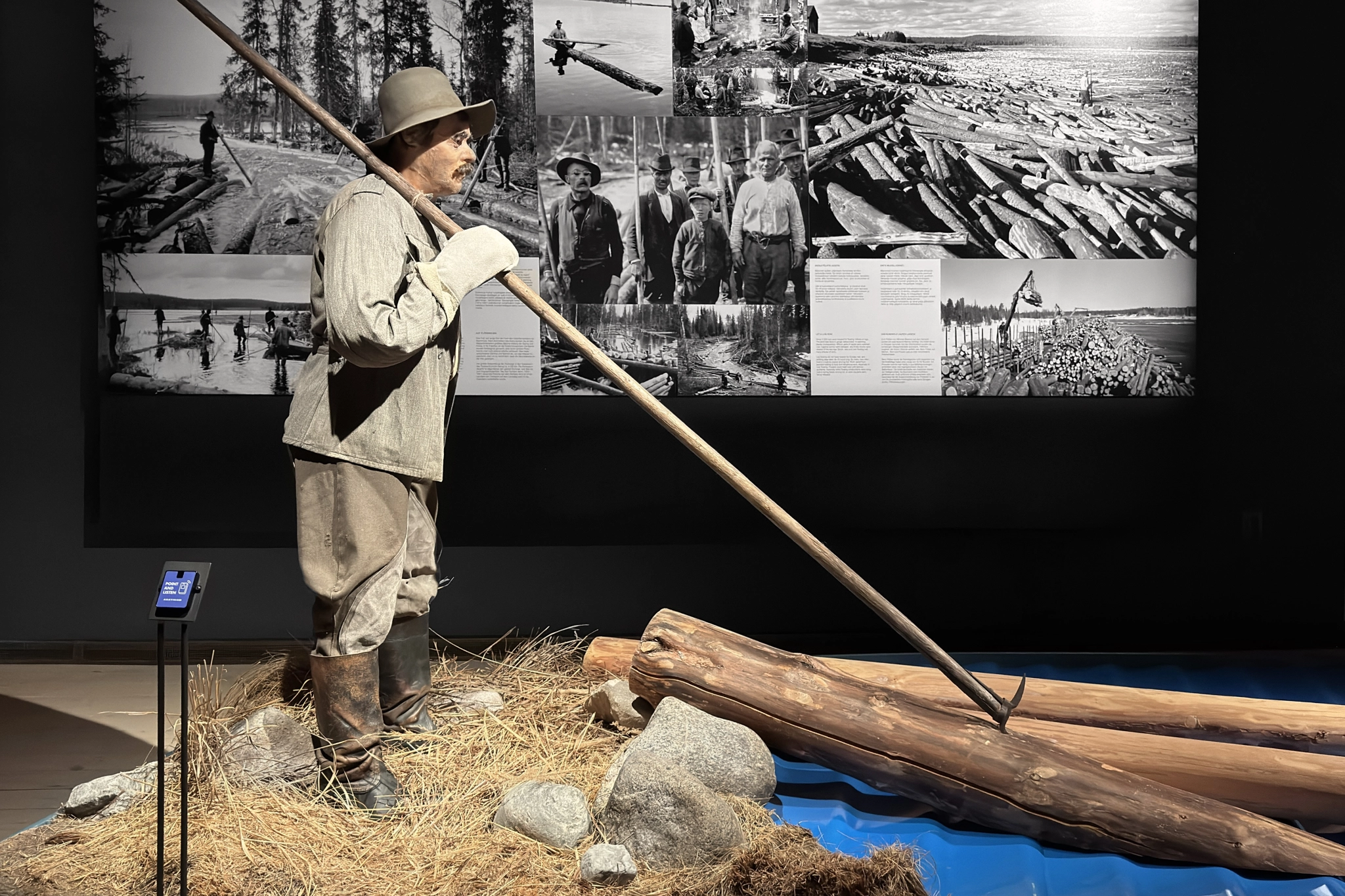
Lapland is one of the main regions in Finland where wood has been felled for industrial needs. The massive logging of wood in Lapland started in the 1870s. Forestry work was an economically significant source of income for thousands of men and hundreds of women and young boys every year, and the logging sites that operated during the winter were like large factories in the forest. You could even say that forest work brought the economy into the lives of people in the wilderness.
The work and life of the forest workers was hard: trees were felled by muscle power with a two- man -saw or hacksaw, and horse-drawn sleds were loaded with logs. In the winter log forests, housing and living conditions were primitive, and the men's clothing, equipment and food were woefully inadequate. The women worked as housekeepers on the sites. They cooked, cleaned, washed bedclothes, carried wood and water and heated the saunas. Their work made the living conditions of forest workers significantly more comfortable.
Tree logging culture involved much social interaction. After long working days outside in the cold, the forest workers returned to the cabin to eat, repair tools, take care of the horses and sleep. In the evenings, they took saunas, played cards and told stories. Forestry workers often came from southern Finland, and many of those who came also stayed in Lapland.
When the rivers were freed from their ice cover in the spring, they began to float the logs, felled in the winter along them, towards the factories on the coast. In the spring and summer people lived in sheds by the rivers. Back then, he working week was long and hard. Sailing on the back of logs required great skill and unfortunately, accidents were not uncommon. The timber rafting competed for the use of the waterways with fishermen, because the logs often broke the river's salmon dams.
The nature of forest work changed decisively with the invention of the tractor and the chainsaw. From the 1960s, timber began to be transported to an increasing extent by log trucks and freight trains, and rafting began to decrease.
Workers were starting to drive to forest work and timber rafting began to disappear. It meant a big change in life in Lapland. Many jobs disappeared, as well as a certain culture and a way of life.
The last timber rafting was in Kemijoki in the summer of 1991. However, tradition-loving log-rafters can still be seen showing off their skills in the timber rafting competitions, which are held in different parts of Finland in places where logging was once practiced. In addition to wood products and paper, the forest industry has expanded to use wood as a raw material, for example in fabrics, in the production of medicines, chemicals, groceries, animal feed, plastics, cosmetics, smart packaging and transport biofuels.

Theme
