Loading...
18. Sámi: basic information, languages, living culture and Sámi costumes.
18. Sámi: basic information, languages, living culture and Sámi costumes.
00:00
00:00
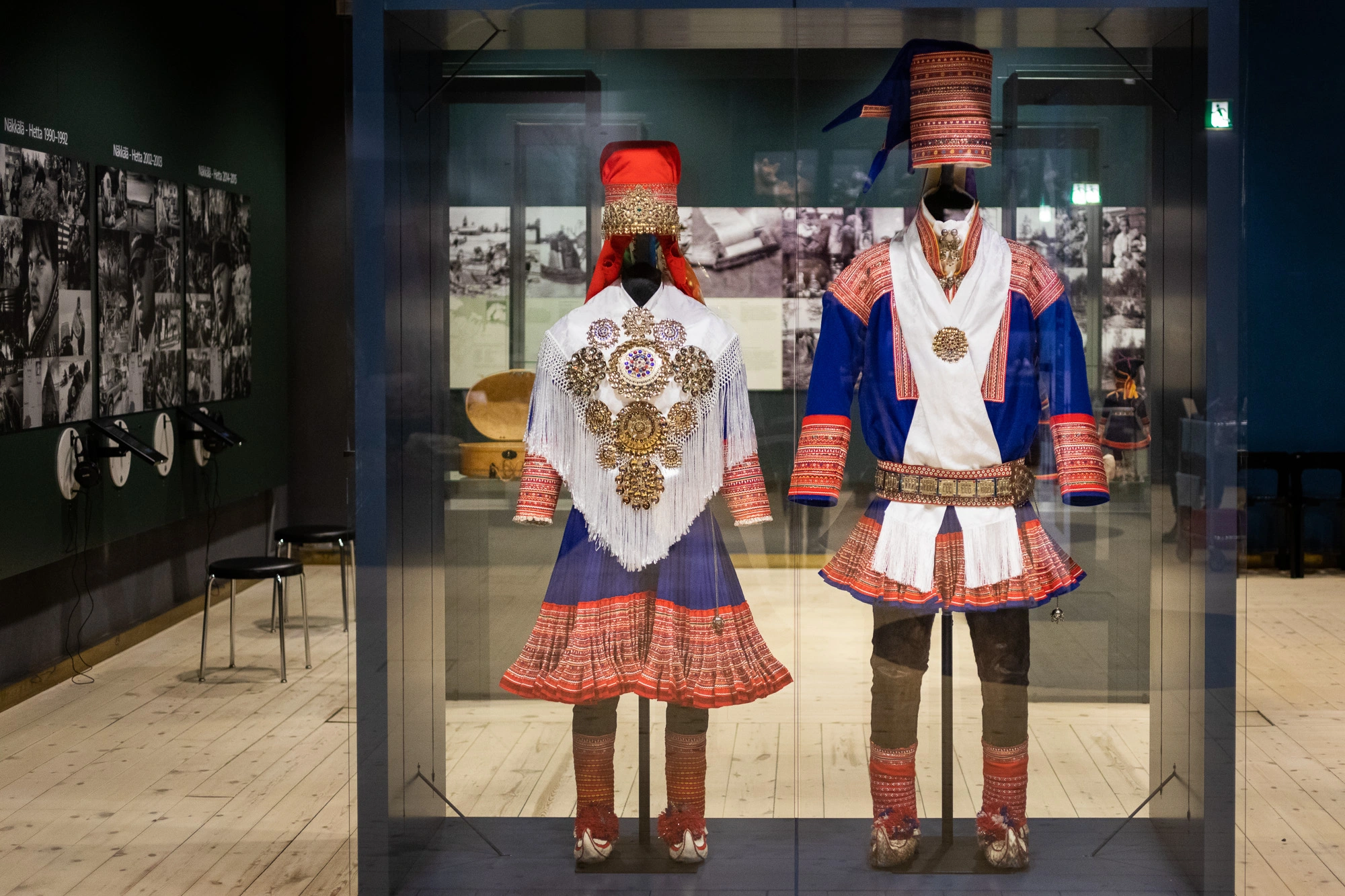
The festive costume ensemble in the display case in front of you is the costume worn by a Sami wedding couple at their wedding. Let's get to know the Sámi a little more, and study this costume in more detail.
The Sámi are the only officially recognized indigenous people in Europe. Sámi Homeland is a region that has traditionally been an area inhabited by Sámi people in the northern parts of Scandinavia; In Finland, Sweden, Norway and Russia. Today, the majority of Sámi people live outside the Sámi region.
Sami is a living culture. There are approximately 75,000 to 100,000 Sámi people in the world, depending on your method of counting. Most of them live in Norway whilst some also live in Russia. About 10,000 Sami people live in Finland. More than half, up to 62% of them live outside the Sami region.
There are ten different Sámi languages, and the most widely spoken is Northern Sámi. It is spoken by about 85% of Sami for whom the language as their mother tongue.
There are three different Sami-speaking groups in Finland: the Inari Sami, the Skolt Sami and the Northern Sami. They all have their own cultural customs and traditions, which are expressed, for example, in Sámi costumes and handicrafts. In Sámi costumes, it is always essential to preserve the model of one's own group, region or even family.
The Sámi have had long trade connections through the ports of the Arctic Ocean all the way to Central Europe. The earliest materials for Sámi clothing were obtained from the skins of reindeer, hare, otter and seal. A jacket made of net fabric came into use in the Middle Ages. Along with trade, woollen fabrics, silks, silver and other metals, pearls and decorative ribbons also evolved into Sami crafts.
Due to the mobile way of life, the traditional items used by the Sámi people have always been durable, practical and light. Many makers of Sámi handicrafts renew both the traditional design language, elements and the use of materials, and thus the handicraft tradition remains alive and flexible.
There are five different models of Sámi dress in use in Finland: the Utsjoki, Inari, Enontekiö and Vuotso models and the dress of the Skolt Sámi. The Sámi costume varies according to the seasons and its intended purpose. A casual dress is decorated more modestly than a formal dress. The most cheerful display of costumes is always seen where the Sámi people gather for big parties or meetings.
The wedding dress ensemble you are looking at was used in Kautokeino in northern Norway at the end of the 1980s. The suits are Enontekiö's model. Both the bride's dress and the man's coat, trousers, fur shoes, and both caps are sewn by the bride herself. Large buckles of circle-shaped pieces of jewelry attached to the front of the bride's coat, belt decorations and other jewelry are all made by a silversmith. The crown attached to the bride's headdress and the decorative chains hanging from the back with silk ribbons are particularly fine and are made to match by a silversmith according to the model of the bride's family.
There are many subtle features and hallmarks associated with Sámi clothing. The cut, decoration and colour of the suits can be used to determine the home region, village or even family of the wearer. These subtle messages related to the use of the suit are often difficult for an outsider to notice. Only Sámi people can wear Sámi clothing.
Theme
