Loading...
20. Petsamo
20. Petsamo
00:00
00:00
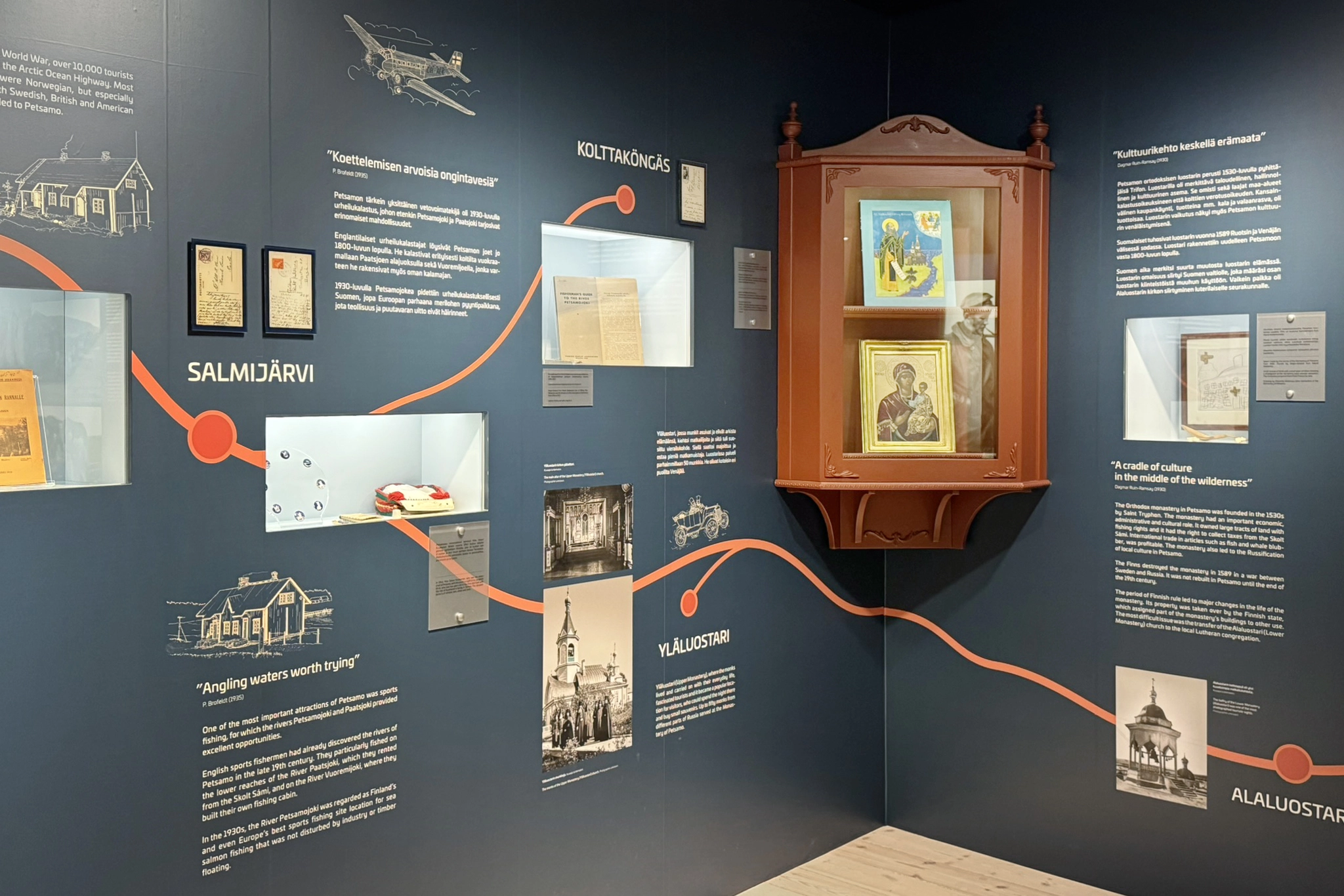
Finland is often said to be shaped like a woman with her hand raised towards the west. Petsamo was the second, "eastern arm" of the Finnish maiden, which reached towards the northeast and whose fingers touched the Arctic Ocean. It was assigned to Finland in the Treaty of Tartu in 1920, when the border areas between the Soviet Union and Finland, which had gained independence three years earlier, were confirmed. Petsamo belonged to Finland for twenty years, until 1944.
Finnish resettlement gained the upper hand in Petsamo when it was ordered to be taken over by Finland. Since the middle of the 19th century, Finns, Viena-Karelians, Russians and Norwegians had moved to the area, and before them, the Skolt sámi had already lived there.
Being part of Finland, Petsamo developed enormously and big dreams and financial hopes were attached to the area. The settlement of Finns in the area was hugely popular and livelihoods came from fishing and fish processing, port operations and tourism, and in the summer there was small-scale farming and reindeer husbandry. Along with population growth, livelihoods diversified in the field of trade and transport.
In Petsamo, the sea and the strong seasonal changes gave rhythm to life. The atmosphere was very multicultural and active: the youthful population danced, played sports and practiced their culture in a variety of ways.
Petsamo fascinated both travellers and adventurers, and as a result, tourism in Lapland began to thrive. Petsamo was considered the most famous and most interesting tourist destination in Finland in the 1930s, even abroad. The exoticism of the area with its rugged landscapes and modern hotels attracted thousands of tourists. The road leading to Liinahamari was completed in 1931 and opened up easy access to the Arctic Ocean.
Rich ore discoveries were made in Petsamo. In the 1920s, geologists made a discovery that turned out to be the richest nickel ore in Europe. A Canadian-English company founded Petsamo Nikkeli Oy in 1937 and within a few years a mining town arose on Kolosjoki.
In 1939, Petsamo was caught up in the whirlwind of war. The Soviet Union occupied it during the Winter War, but handed the area back to Finland in the spring of 1940. In the summer of 1941, German soldiers arrived in the area, as the military industry desperately needed materials mined from the area's nickel mines. About 90 percent of the output of the nickel mine went to the needs of the German arms industry. The mine had great political significance for Finland during the Second World War.
The Skolt sámi were the original population of Petsamo. They belong to the Eastern sámi because of their language and traditions. By religion, the Skolts are mainly Orthodox. Eastern features can be seen in their culture in clothing, music, customs and food traditions.
Petsamo was annexed back to the Soviet Union in the autumn of 1944. The Finnish population and a large part of the Skolt sámi were evacuated to the Finnish side. At that time, as a result of the Second World War, the Skolt sámi people lost their traditional family area in Petsamo on the Russian side. After the evacuation trips during the war, the Skolt’s were settled in Finland in the villages on the east and north sides of Lake Inarijärvi.
Theme
