Loading...
2. Arctic region, nightless nights and polar night
2. Arctic region, nightless nights and polar night
00:00
00:00
Imagine yourself in a dark and cold place, surrounded by nothing but snow and ice. The wind blows in the ears and the sun doesn’t rise above the horizon even during the day. You can feel the cold in your bones and core. That’s what it’s like to be in the North Pole from September 24th to March 19th. At the North Pole, the polar night lasts almost half a year.
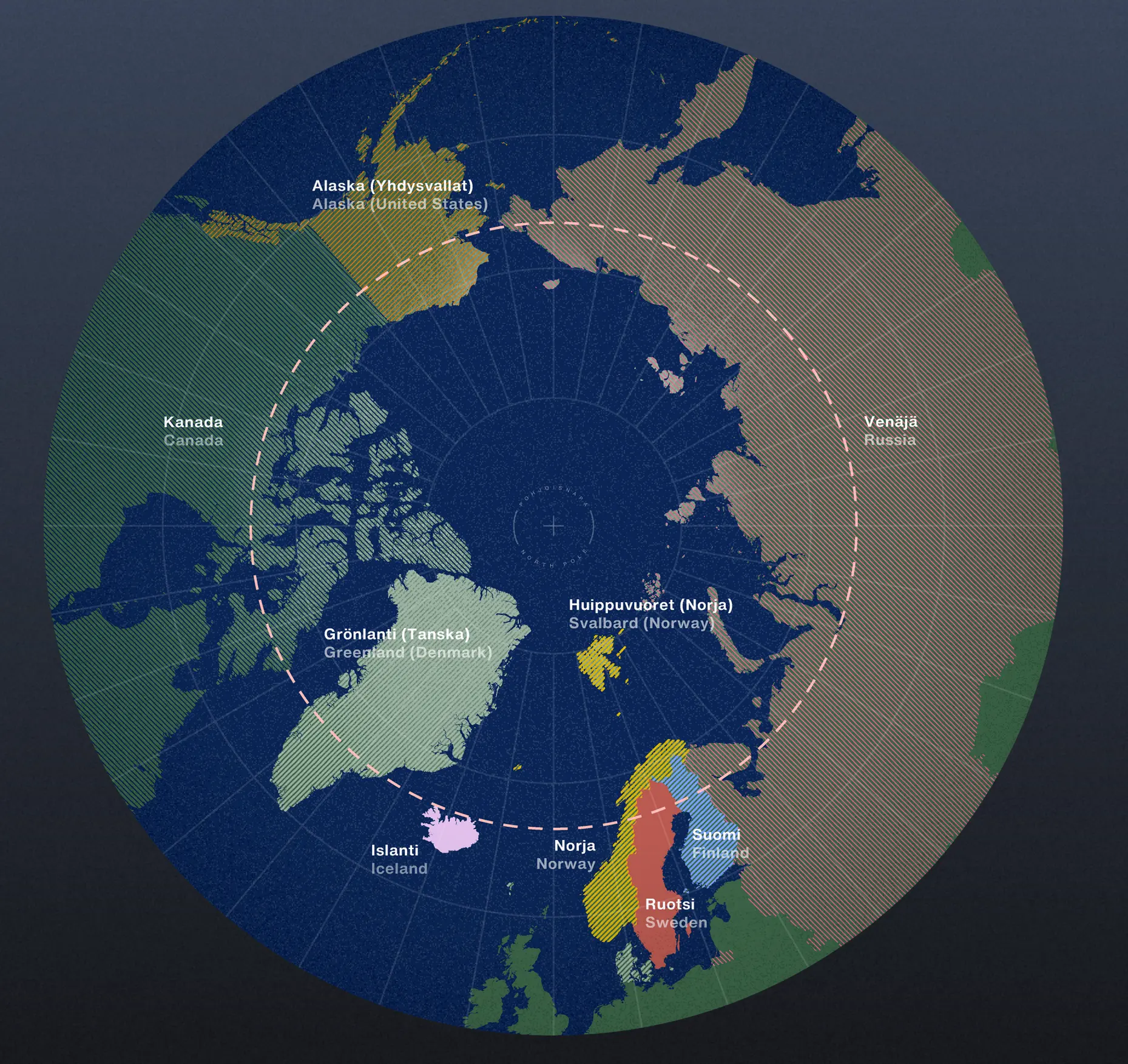
A region of cold climate spreads around the North Pole, called the Arctic region. Its southern border can be defined in many different ways.
The Arctic Circle delimits the Arctic region according to solar radiation. The dark time of the year is called kaamos; polar night, and the light time of summer is called nightless nights. Areas north of the Arctic Circle have at least one day without daylight in winter and at least one day of nightless night in summer.
The Arctic region can also be defined by the temperature. When the average monthly temperature in the region remains below +10°C throughout the year, also in summer, we are in the arctic region. The limit according to the temperature is also followed by the tree line. The tree line is located between the boreal forest zone and the tundra, in which case arctic land areas are mainly treeless tundra and glaciers.
Permafrost is soil that stays frozen continuously for at least two years. Using this definition, Russia's share of the Arctic land area increases, as it has the most permafrost.
The Arctic region can also be defined by sea ice and vegetation zones, as well as cultural and political boundaries.
As the climate warms, the arctic area will shrink if it is defined by temperature, tree line, permafrost or sea ice. Cultural and political boundaries also vary and are changing.
The definition of the Arctic region is also a geopolitical issue. The most permanent of the boundaries of the area is the northern polar circle, although it also moves very slowly due to the variation of the Earth's axial tilt.
The tilt of the Earth's axis and the Earth's rotation around the Sun also cause the different seasons on our planet. The polar regions have very special light conditions associated with the seasons, because the closer we are to the North or South Pole, the stronger and longer-lasting the seasonal variation in the amount of light is. Because of this, there is little daylight in the arctic region in winter, and it is bright all night in summer.
Nightless nights begin when the sun no longer sets behind the horizon. In the middle of the nightless nights is the summer solstice. It will arrive on the 20th–22nd. June, when the earth's axial tilt has reached its maximum towards the sun and the sun is at its highest point. Nightless nights arrives when the sun no longer rises above the horizon. In the middle of polar night is the winter solstice, which in the northern hemisphere is between the 21st and 22nd. December.

Theme
