Loading...
9. Northern lights
9. Northern lights
00:00
00:00
The northern lights have fascinated people throughout the ages. In different cultures, there are many different stories associated with them, and in almost all languages, the name of the polar lights refer to the light seen in the north or south. The polarlights originate from the Sun, almost 150 million kilometers from the Earth.
The Finnish word for northern lights comes from a story in which a fire-fox runs. Sparks are created when the fox's flanks rub against the fells, and its tail shoots those sparks into the sky from the surface of the snow. The Sámi, on the other hand, believe that the northern lights were living beings that talk and understand speech. While they were flaming, the sled was stopped, and you had to be absolutely quiet, because it was believed that they would grab you. Even today, some people believe that the northern lights have the power to heal, or that you can call them by whistling.
Polar lights are formed when electrically charged particles are released from the sun
and collide with atoms and molecules when they enter the Earth's atmosphere. The particles stimulate the atoms and molecules to a higher state of excitation, and that extra energy is released as light.
The polar lights form around both of the Earth's magnetic poles, which is why they can be seen in both the northern and southern hemispheres. The polar lights visible in the north are called aurora borealis and those visible in the south are called aurora australis.
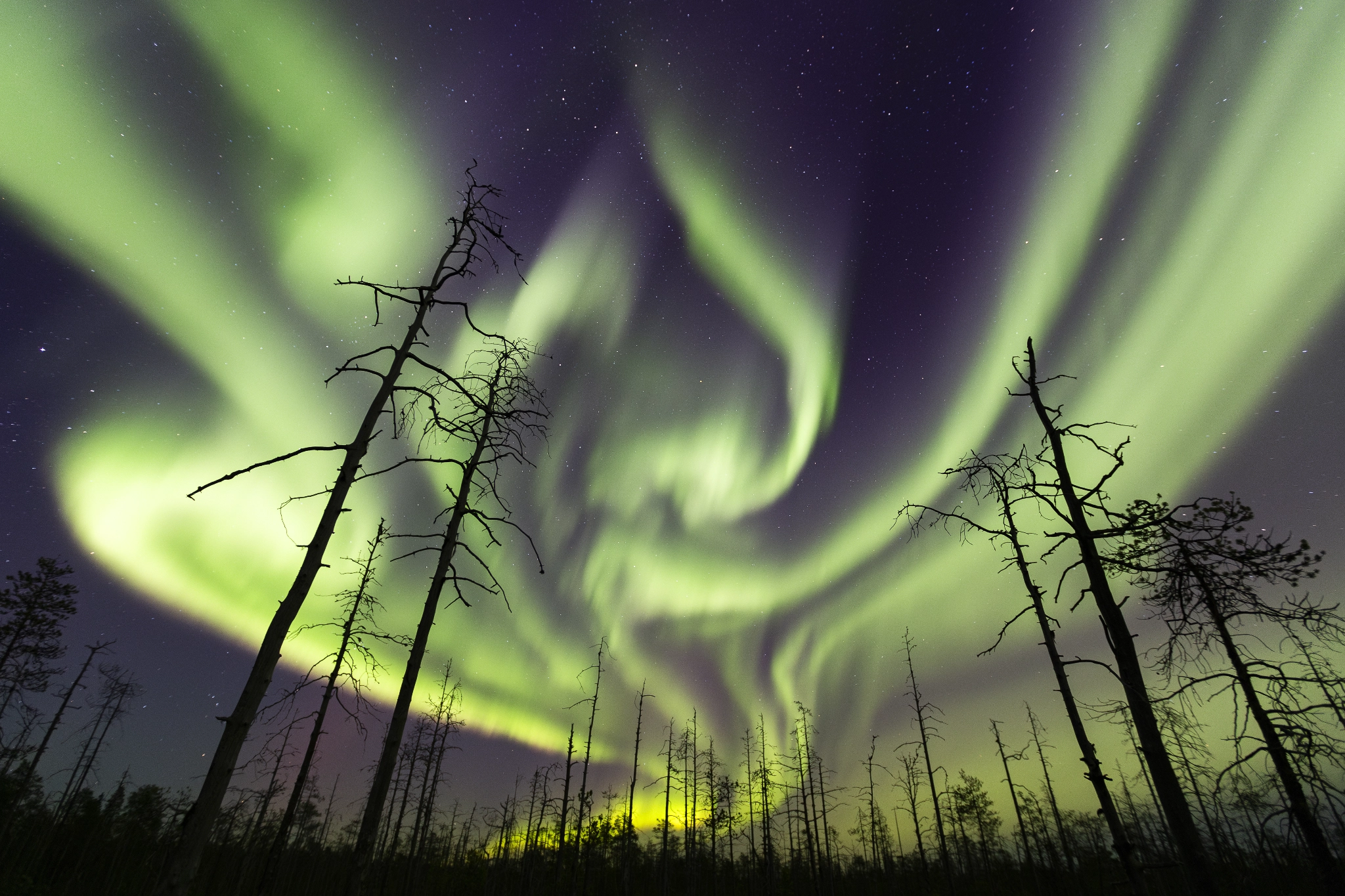
Light appears in different colours and shapes. The colour depends on the quality of the excited particle and the energy it receives in the collision. The main colours of the northern lights are green, red and blue, of which green is the most common and strongest. Purple, yellow and white colours can also be observed.
In the Arctic region, the Aurora borealis are usually green and more diverse in shape than in the south. The radial structure is created when the particles plunge towards the earth along the lines of force of the magnetic field. Further south, the Sun's particles can only penetrate to an altitude of about 300 kilometers. Since the excited state producing the red colour is long, the particles have time to spread themselves widely before they emit their additional energy as light. That's why in the south the northern lights are usually red and scattered in shape.
The appearance of the northern lights is influenced by the activity of the Sun, which varies in cycles of about 11 years. Solar flares and coronal mass ejections release particles explosively. During the subsequent magnetic storms, the aurora borealis are stronger and spread further south than normal.
Seeing the northern lights depends on the time of year, weather conditions and viewing location. In the Northern Hemisphere, the polar lights can best be seen in Northern Fennoscandia, Svalbard, Iceland, Southern Greenland, Northern Canada, Alaska and Northern Siberia. The northern lights are usually seen in early autumn and spring-winter, on both sides of midnight. March is usually the best viewing time because the nights are clear.
However, being able to experience the aurora borealis ultimately depends on good luck. The northern lights also flare in summer, but due to the bright nights, they cannot be seen.
It has been claimed that the northern lights also cause vocalizations, which has long been considered a myth or a hallucination. However, Finnish researchers believe that they have located sounds that appeared at the same time as the northern lights. Sounds similar to each other were recorded on microphones in three different places. The sound source was at a height of about 70 meters. You have listened to the sound of the northern lights throughout this guide.
Theme
