Loading...
1. Kultala Crown Station

1. Kultala Crown Station
GOLD DISCOVERY IN LAPLAND!
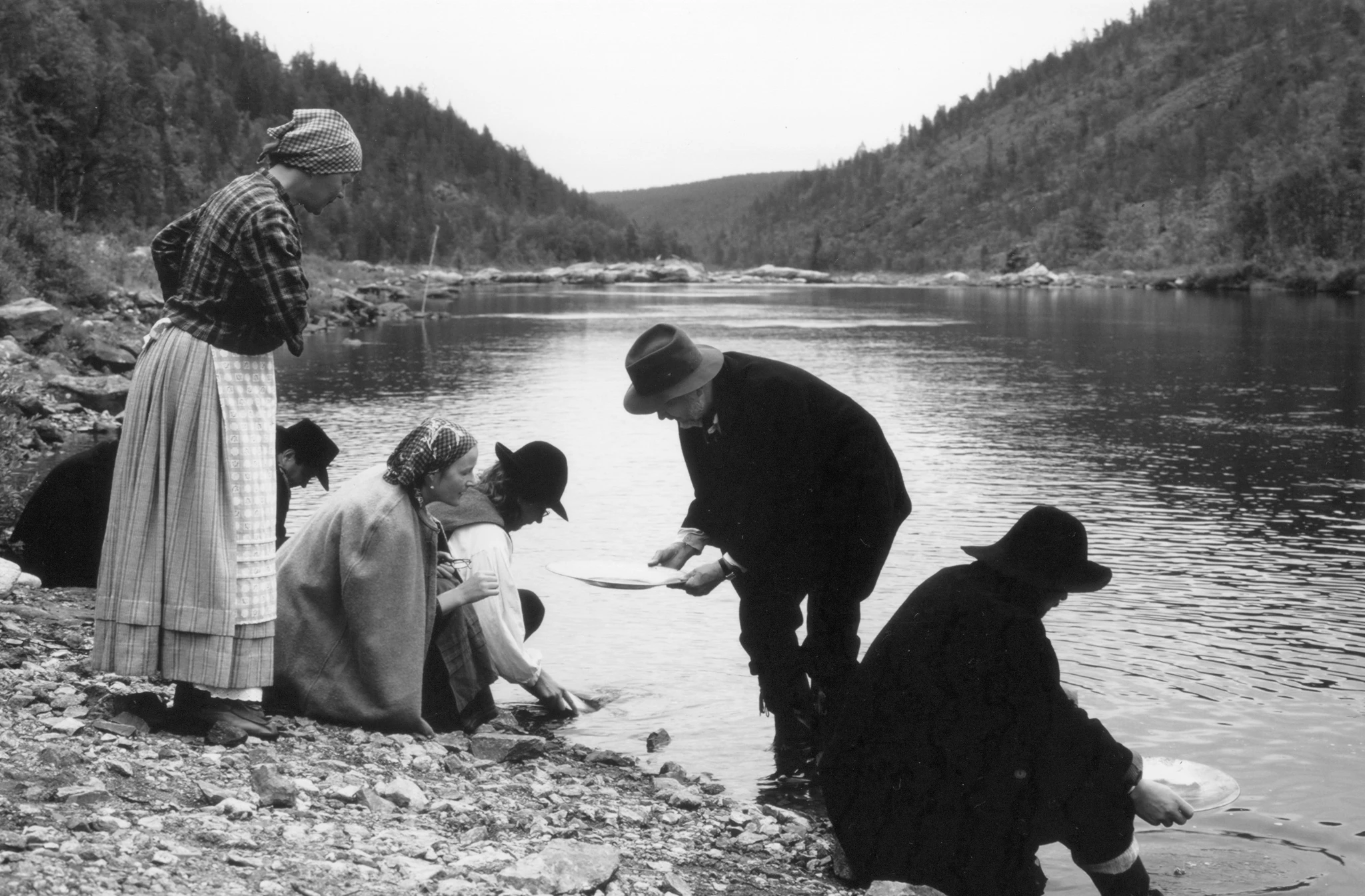
In 1860s, Norwegian geologist Tellef Dahl reported of traces of gold he had found on the banks of the river Teno. Based on his report, an expedition was sent to prospect the shores of this river on the border of the two countries. The leader of the expedition was Mr. J. C. Lihr, the manager of the State Mint. The expedition team finally made a discovery in Nulkkamukka, a bend of the Ivalojoki river, towards the end of summer of 1868. The total result from 12 gold pans was 200 mg of gold chips. Altough that was not much, this was the beginning of a gold rush that greatly affected the development of northern Lapland.
The first gold prospectors of Ivalojoki
The news of the gold discovery soon spread out and the first prospectors arrived in summer 1869. The luckiest of them were sailors Jacob Ervast and Nils Lepistö: in four weeks they panned more than two kilos of gold! Later that summer Edward Björkman of Raahe panned 600 grams of gold from the same deposit.
Declaration from His Majesty the Emperor
The Ivalojoki gold discovery was considered so important that on the 8th of April in 1870, the Senate of Finland announced a declaration signed by Emperor Alexander II. The declaration contained a statute governing prospecting and panning for gold in Finnish Lapland. According to this statute, every reputable citizen of Finland and Russia – excluding Jews – was allowed to prospect for gold.
Kultala Crown Station
An outpost for government officials for keeping order in the gold field was built on the bank of Ivalojoki: Kultala Crown Station. In addition to the main building, there were living quarters, bakery, store and sauna. The main building of Kultala accommodated government officials. The supervisor of the outpost was Anders Thoreld, the highest mining authority in Lapland, assisted by Johan Konrad Lihr, the finder of the Ivalojoki gold. The number of government officials in Kultala outpost totaled to 38 men. Initial plans of the main building also included an infirmary for up to eight patients. This plan was changed and later a small hospital was built in Ivalo.
The site plan of Kultala
In addition to the buildings of the outpost, several gold prospector dwellings and roads to Ivalo and Hammasjärvi are shown on the site plan of Kultala of 1882. The map also shows claims in the area and the water trough from the foot of Paavonkallio hill.
The governor in Kultala
Mr. Georg Von Alftan, the governor of Oulu province, together with province secretary, Mr. Konstantin Hilden, visited Kultala in July 1870. This occasion was witnessed by a number of wellknown persons of the gold field, such as Thoreld, Lihr, Dahl, Ervast, Lepistö, Björkman, and Planting. Von Alftanin left Oulu on the 16th of July, travelling first on a horse carriage to Kittilä and then by foot to Kultala, where he arrived eleven days later. The governor’s party stayed three days in Kultala. On the way back the party first travelled by foot along the Kivioja creek to the headwaters of the Vaulojoki river and then by rowing boat down the river. They were back in Oulu on the 7th of August.
Kultala, laboratory of aurora borealis
Year 1882 was the international year of geophysics, and Kultala was the base for the expedition of Finnish geophysicists. The purpose of the expedition, led by Karl Selim Lemström, was to carry out research related to northern lights, on the top of Kehäpää hill. To assist the research, Kehäpää and Kultala were connected by a telephone line, the first of its kind in Lapland.
Claims and mining districts on Ivalojoki
An official license was required to prospect for gold. Licenses were granted by the governor of the province of Oulu and in summer also by Lapland’s mining authority. The price of the license was 100 marks. Anyone found panning for gold without a license was fined 150 marks. The license authorised four men to carry out prospecting in an area covering 1000 x 150 fathoms (1781 x 267 meters). If the area proved to be worth mining, this should be reported to the mining authority. He would then send a claim application to the governor. When the claim application was confirmed, the area was declared a mining district. The authorities required detailed records on activities carried out on the claim and for all the gold recovered. The production of the mine was delivered to the mining authority. He paid in advance 50 % of the total value of the gold. The rest was paid later after taxes and costs of transportation and melting were first deducted. Free trade of gold was not allowed.
The whole village prospered
Ruikanmutka was one of the richest deposits of the Ivalojoki river. A short stretch on the west bank of the river produced more than 30 kilos of gold in the early years of 1870s. The owner of this claim was Matti Yliruikka of Ruikka, a village south of Rovaniemi. Prospecting on the claim was financed by the villagers of Ruikka. About twenty men were working on the claim in 1871. The whole village of Ruikka prospered of the Ivalojoki gold. Matti Yliruikka built himself the biggest house in northern Finland. Later the logs of that house were used to build three smaller, yet handsome houses. They are still owned by the same family
Rush to Ivalojoki is over, prospectors move to tributaries
When the richest deposits of Ivalojoki were exhausted, prospectors moved to the tributaries. Palsinoja was among the richest creeks in 1870s and Sotajoki on the following decade. Gradually prospecting in the area died out for almost a century, until hobby prospectors found Ivalojoki again in early 1980s
Theme
