Loading...
4. Gold in solid rock

4. Gold in solid rock
Gold in solid rock
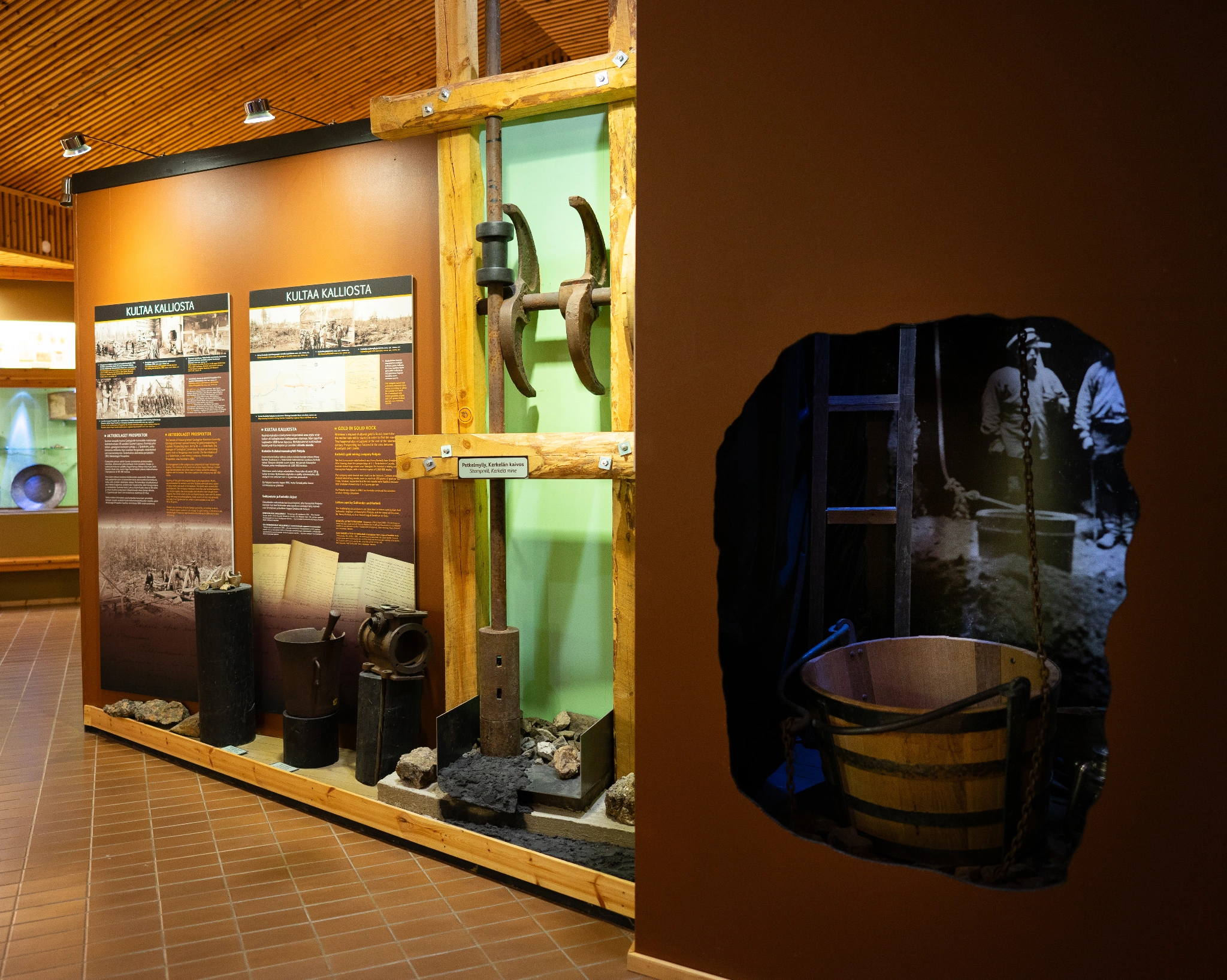
Whenever a deposit of alluvial gold is found, search for the mother lode will be started in order to find the source. This happened also in Lapland at the end of the nineteenth century. Prospecting was focused in the area between Kaunispää and Laanila.
Kerkelä's gold mining company Pohjola
The first to excavate solid bedrock was Henry Kerkelä from Kemijärvi. After hearing about the prospectings of J.J. Sederholm in Laanila, Kerkelä staked large claims near Tolosjoki. He founded a mining company, Kaivosyhtiö Pohjola, with a nominal capital of 1.800 000 marks.
The company sunk several mine shafts in the bedrock. Content analyses showed astonishing results, even as much as 286 grams of gold per ton. It was, however, suspected that the test results were falsified, because later analyses showed only 1 to 3 grams per ton
Oy Pohjola was closed in 1902, but Kerkelä continued his activities in other mining companies.
Aktiebolaget Prospektor
The Senate of Finland granted Geologinen Komissio (currently Geological Survey) special funding for gold prospecting in Lapland. Prospecting team, led by Mr. J.J.Sederholm, the manager of Geological Commission, located an interesting quartz lode in Hangasoja near Laanila. On the initiative of J.J.Sederholm, a new mining company, Aktiebolaget Prospektor, was founded in 1901.
The management of the company was composed of major Finnish industrialists. The chairman of the board was senator August Ramsay. Colonel Hugo Standertskjöld, the richest man in Finland, joined the company together with his brother. The share capital of the company was 165 000 marks.
Opening of the gold mine required large-scale preparations. Roads, accommodation for workers and mine facilities were built and a dozen of deep shafts were sunk in the bedrock. The shafts were named after the financiers. The company employed more than one hundred workers.
Two steam engines, two mine pumps and elevators were bough from England. Two of the shafts, Lutto and Kaarle Kustaa, were over 50 meters deep with long horizontal galleries. Gold content of rock was generally low, only 1 to 2 grams per ton, while in some samples it was even 15 to 50 grams.
Despite the estimates of some foreign specialists, according to which the Ivalojoki region could be rich enough for gold mining in industrial scale, Aktiebolaget Prospector was forced to discontinue in 1904 due to lack of funding.

Theme
