Loading...
3. Snowflake
3. Snowflake
00:00
00:00
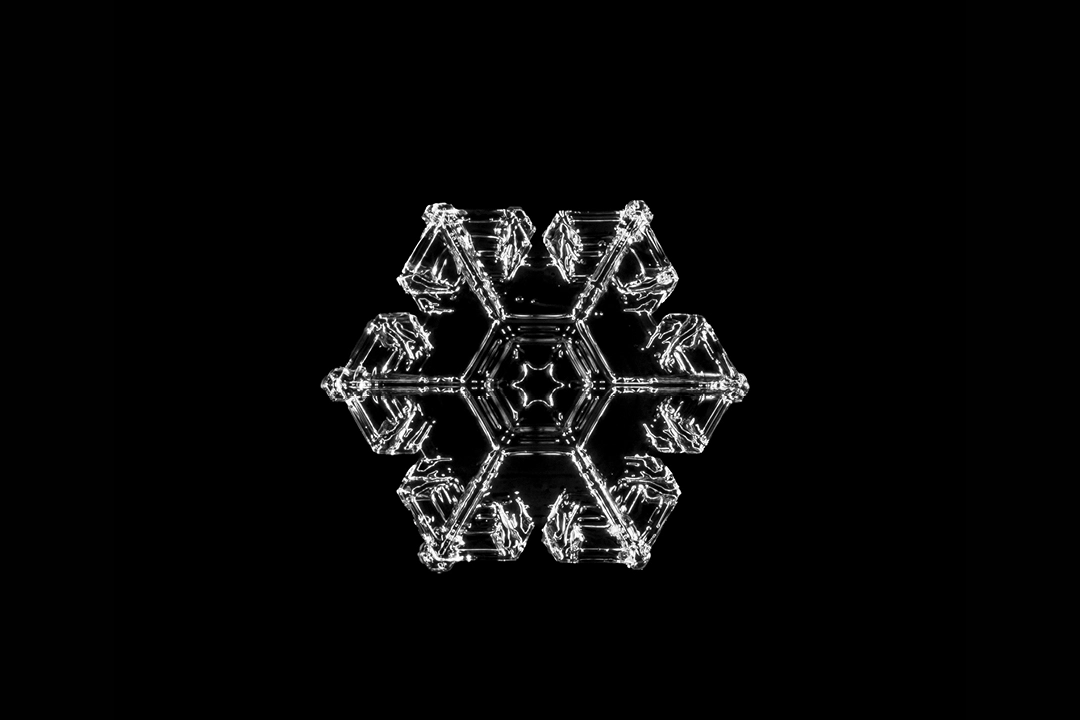
A star-shaped snowflake slowly floats towards the ground. There are millions of other snowflakes around it, but none are exactly the same. The journey to the surface of the Earth is long and different for each snowflake.
A snowflake can be either a single crystal or a cluster of crystals. A snow crystal is formed in the air around a particle, such as a dust particle. Water vapour begins to turn into a crystal by deposition: it completely skips the liquid phase and transforms directly into solid.
The shape and size of a snow crystal is determined by temperature and humidity. The snow crystal is always hexagonal due to its building material, the water molecule.
The points of the star-shaped snow crystal might look similar to one another, but they are never identical. The similarity is due to the tendency of water molecules to form regular hexagonal structures when they freeze. However, even small changes in the conditions can interrupt the growth of a perfect snow crystal.
Can there be two identical snowflakes, then? Even though snowflakes may look alike, it is extremely unlikely that there would be two identical snowflakes. One star-shaped snowflake can contain a quintillion water molecules.
In freezing temperatures, ice crystals float to the ground and remain intact. A squeaking sound is created when the points of dry, star-shaped ice crystals break under the shoe. The colder the temperature, the louder the crunching sound made by walking. In mild weather, the shape of the ice crystals is simpler, the crystals are softer, and they have water on their surface that absorbs sound.
Snowflakes can be classified in many different ways. A star-shaped crystal is called a stellar dendrite. Get to know it and other art of nature in our exhibition.

Theme
