Loading...
Home kitchen from the 1950s
Home kitchen from the 1950s
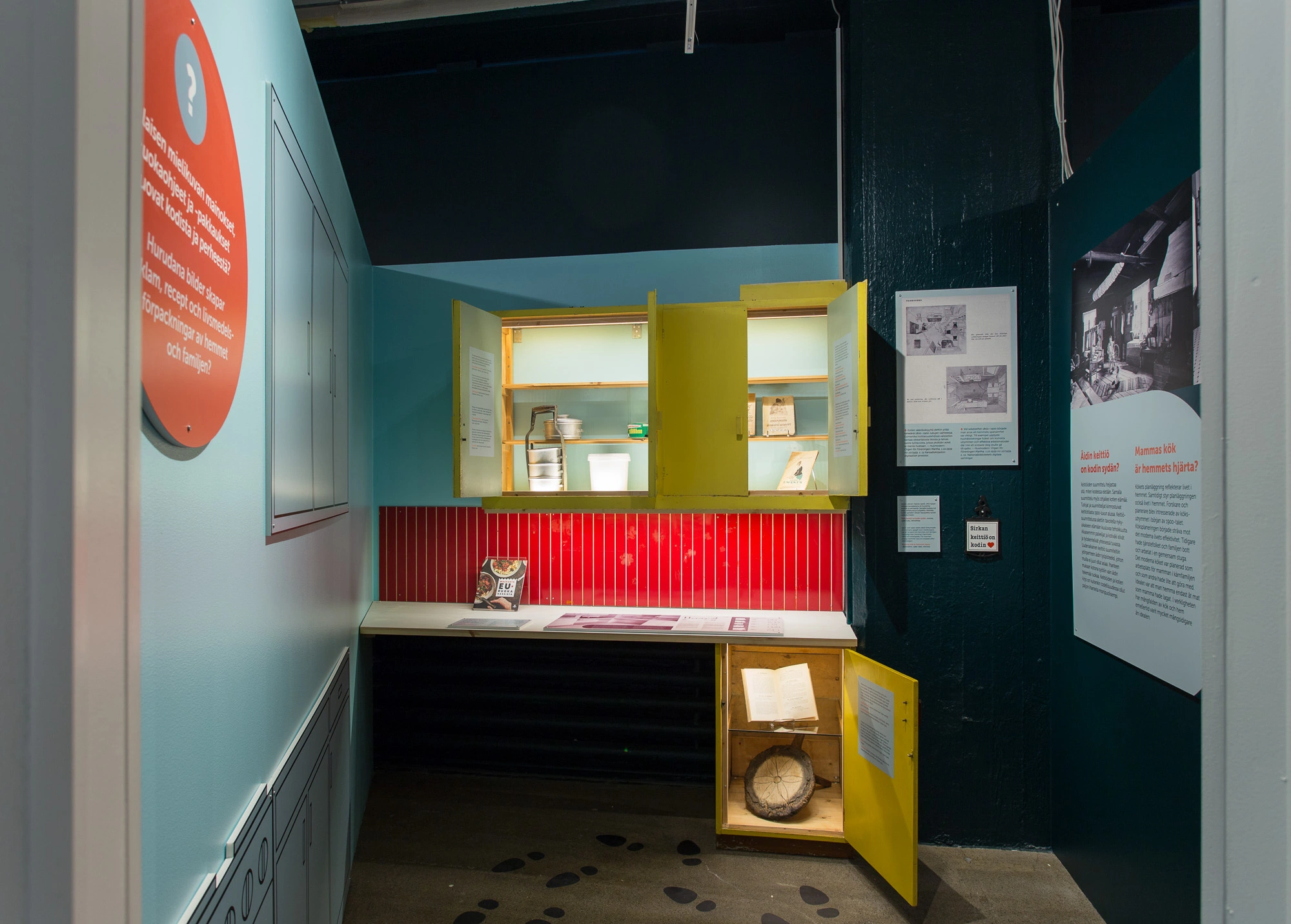
Step into a 1950s home kitchen. You can peek inside the cabinets by opening their doors.
The design of kitchens reflects how life is lived in homes. At the same time, design also shapes life at home. Researchers and designers became interested in kitchen spaces in the early 20th century. Kitchen planning began to aim for the efficiency associated with modern living. In the past, servants and household members lived and worked together in a shared main room. The modern kitchen was designed as the workspace of the nuclear family’s mother, a place where others rarely entered. The ideal was that meals at home were prepared only by the mother. In reality, the variety of kitchens and homes has always been much more diverse than the ideal.
You can peek inside the kitchen cabinets by opening their doors.
Upper left cabinet: Many small city apartments lacked a kitchen until the mid-20th century. Food could be picked up from, for example, a co-operative kitchen, a restaurant, or a public kitchen. By the 2000s, picking up pizza or fast food for home had become common. When restaurants were ordered to close in 2020 due to the COVID-19 crisis, they offered takeaway options such as dinner kits, Mother’s Day brunches, and packed lunches for schoolchildren.
Objects in the cabinet:
Food transport container, or “porttööri,” Restaurant Lehtovaara, Helsinki, 1930s–1950s
Soup bucket, Café Vanhan Porvoon Glassikko, Porvoo, 2020
Upper right cabinet: In the early 20th century, architects and home economics advocates promoted the ideal of a home occupied by a nuclear family, with the mother personally responsible for the family’s meals, household cleanliness, and budgeting. Homemaking became a full-time profession, and numerous guides on the subject were published.
Books in the cabinet:
Kerstin Wenström: Husmoderns 1000 recept. Wahlströms förlag, 1924
Hanna-Helena Kunnas: Keittokirja äideille ja tyttärille. Karisto Oy, 1991 [1st edition 1914]
Elina Kanervio: Kodinhoito ja ruokatavaraoppi vasta-alkajille. Kustannusosakeyhtiö Kirja, 1920
Arla Pohjanpää: Nuori emäntä. Gummerus, 1924
Lower cabinet: In the past, cooking was physical labor and considered women’s work. It was learned by example and hands-on practice. Home economics education brought written recipes into homes in the early 20th century. Courses run by organizations, home economics manuals, and magazines also helped turn many local traditional dishes into widely known national foods.
Objects in the cabinet:
Cheese bread board for baking cheese by the fire, early 20th century
Cheese recipes: Amalia Grönberg, Kansan kotiruoka ja kotitalous. Otava, 1910
Kitchen table: Tasty Meals from the EU Food Bag publication (Marttaliitto & Finnish Food Authority, 2019). In 2020, around 100,000–200,000 people in Finland relied on food aid. Most aid is distributed by organizations and parishes. EU-funded food aid has been provided since 1996. In 2019, Marttaliitto and the Finnish Food Authority published a recipe booklet to help prepare meals from the contents of a food aid package.

Theme
