Loading...
School cafeteria
School cafeteria
In Finland, almost everyone eats meals prepared by food services at some point in their life — in daycare, school, the military, the workplace, hospital, prison, or a care home. Meals eaten outside the home can influence the wellbeing of both people and the environment, as well as food culture in general. Public food services, such as school meals, are funded by taxes. Service providers must follow nutritional recommendations, which are national guidelines for healthy eating.
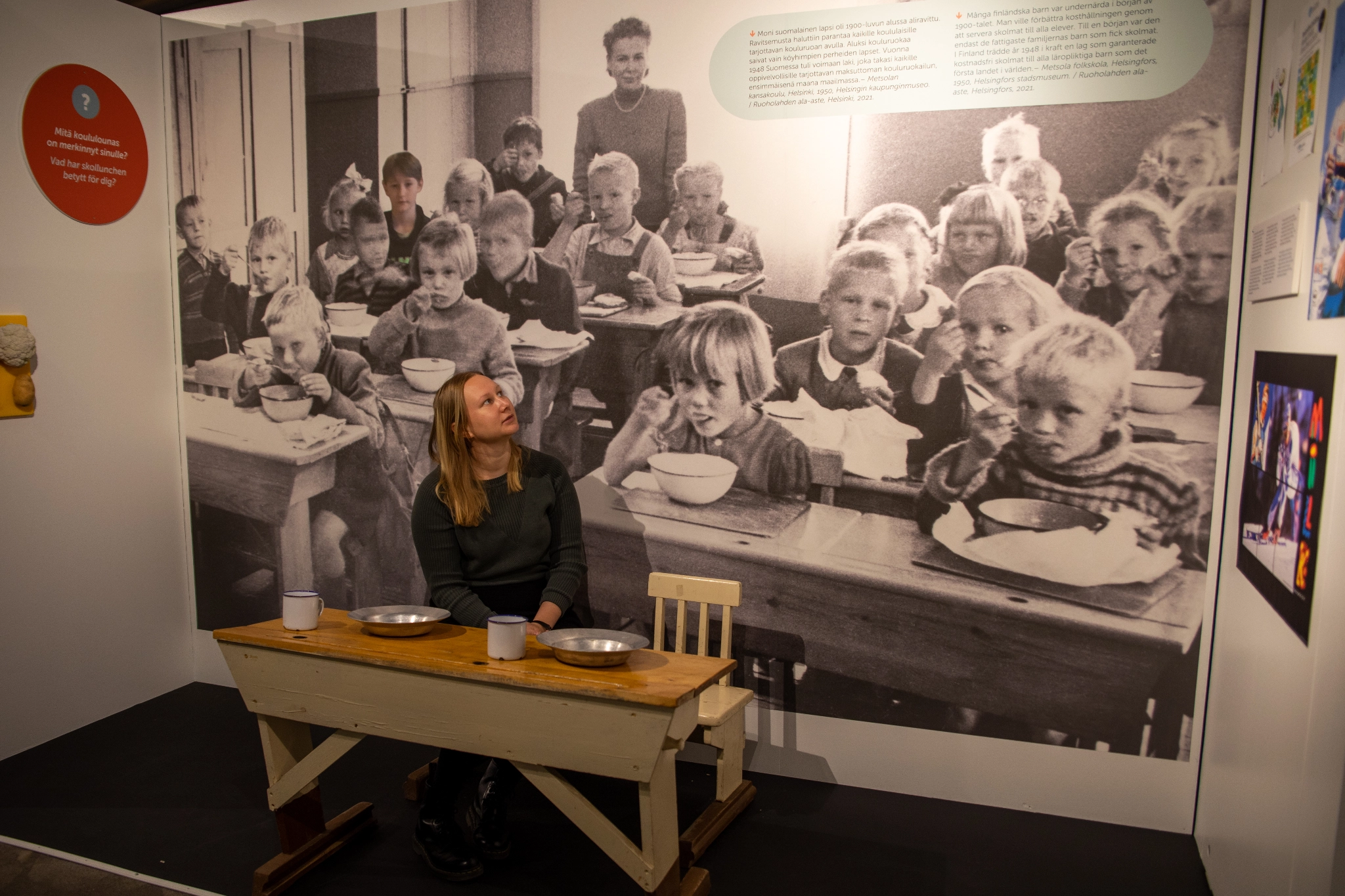
In the early 20th century, many Finnish children were malnourished. Nutrition was improved through the provision of school meals for all pupils. At first, only children from the poorest families received school food. In 1948, Finland became the first country in the world to pass a law guaranteeing free school meals for all pupils subject to compulsory education. Early school meals were usually porridge, gruel, or soup. Knives and forks were introduced to school canteens in the 1960s as the variety of meals increased. In the early years, pupils brought milk and bread from home. They also had to take part in growing and gathering food supplies.
Objects on display in the showcase:
Top shelf:
Lunch voucher from the late 1990s. An employer can support employees’ meals by offering, for example, lunch vouchers or another food benefit, which is taken into account for taxation purposes. Lunch vouchers were introduced in Finland in 1974.
A plate, cutlery, drinking glass and salt shaker from the Osuuskunta Ylensyöjät catering service in Helsinki from 1996, as well as an Osuuskunta Ylensyöjät membership card from 2002, from a private collection. Workplace catering can be organized by the employer, a private entrepreneur or, for example, a workers’ cooperative. The Yleisradio employees’ cooperative Osuuskunta Ylensyöjät operated from 1972 to 2005. It was one of the first workplace restaurants to offer a salad bar and a vegetarian option. The self-served starter salad in particular was a big hit.
Bottom shelf:
Spoon-fork combination utensil (1944) and mess kit (1940) from the collections of the War Museum. Field meal menu from the Leijona Catering garrison restaurant Somero in Rovaniemi from 2021.
The Finnish Defence Forces and prisons’ food services are managed by the state-owned Leijona Catering, which prepares about 70,000 meals per day. Catering must also function in field conditions.

Theme
