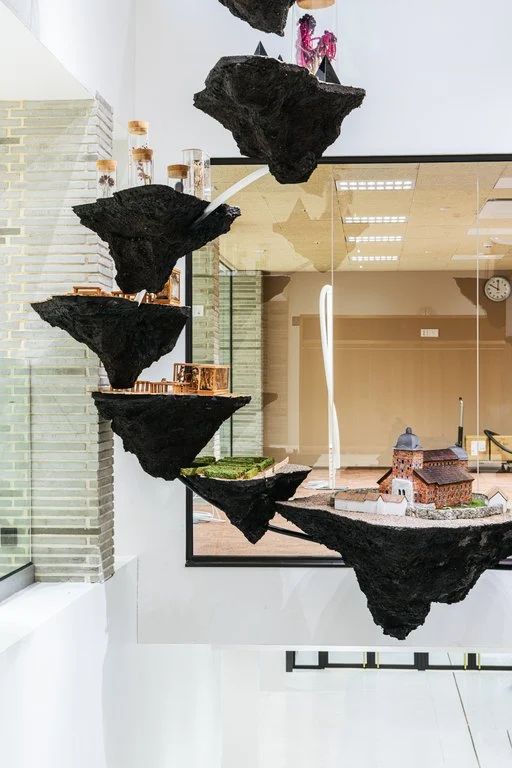
Archipelago of Possibilities


Archipelago of Possibilities
The work explores layers of time and the significance of knowledge in a unique and modern way. It consists of island-like shapes, similar to landscape fragments carved from the ground, held together by a rising circle. It presents time as an archipelago of possibilities where the past, the present, and the paths branching from choices not yet made are always present. The work is based on repetition, where the same visual elements reappear with small variations, like overlapping or successive versions of reality.
The starting point is the idea that an institution producing knowledge was already in medieval times part of the defense system, something that feels highly relevant today. At the same time, the work can be seen as a symbol of scientific practice and how scientific knowledge is refined through different iterations in pursuit of truth.
The landscape it portrays is a fragment from the university’s history. Finland’s first university, the Royal Academy of Turku, was founded in 1640 and located in a small building in the wall surrounding the Cathedral. This indoor artwork was commissioned directly from the sculptor Jouna Karsi.
Read more about the artist
Jouna Karsi is a trained sculptor from Turku Arts Academy. He primarily works with easily shaped insulation materials to create his sculptural miniature landscapes. His work is positioned above the open stair area between the first and second floors.
He begins by cutting and shaping the piece with large machinery, which gives it a rather rough and angular structure. After that, he develops the detailed elements of the work piece by piece. Much of the creative process takes place during this stage. Jouna uses many natural materials to shape the small details, such as dried branches, flowers, moss, and so on. Colors and forms are crucial when choosing, for example, which flower will become a tree. The interior color palette of Astra also influences the color choices in the artwork.
At the center of the piece is the main island with a church, which serves as the work’s starting point. By studying historical sources and drawings, the artist has aimed to depict the church as accurately as possible.