Loading...
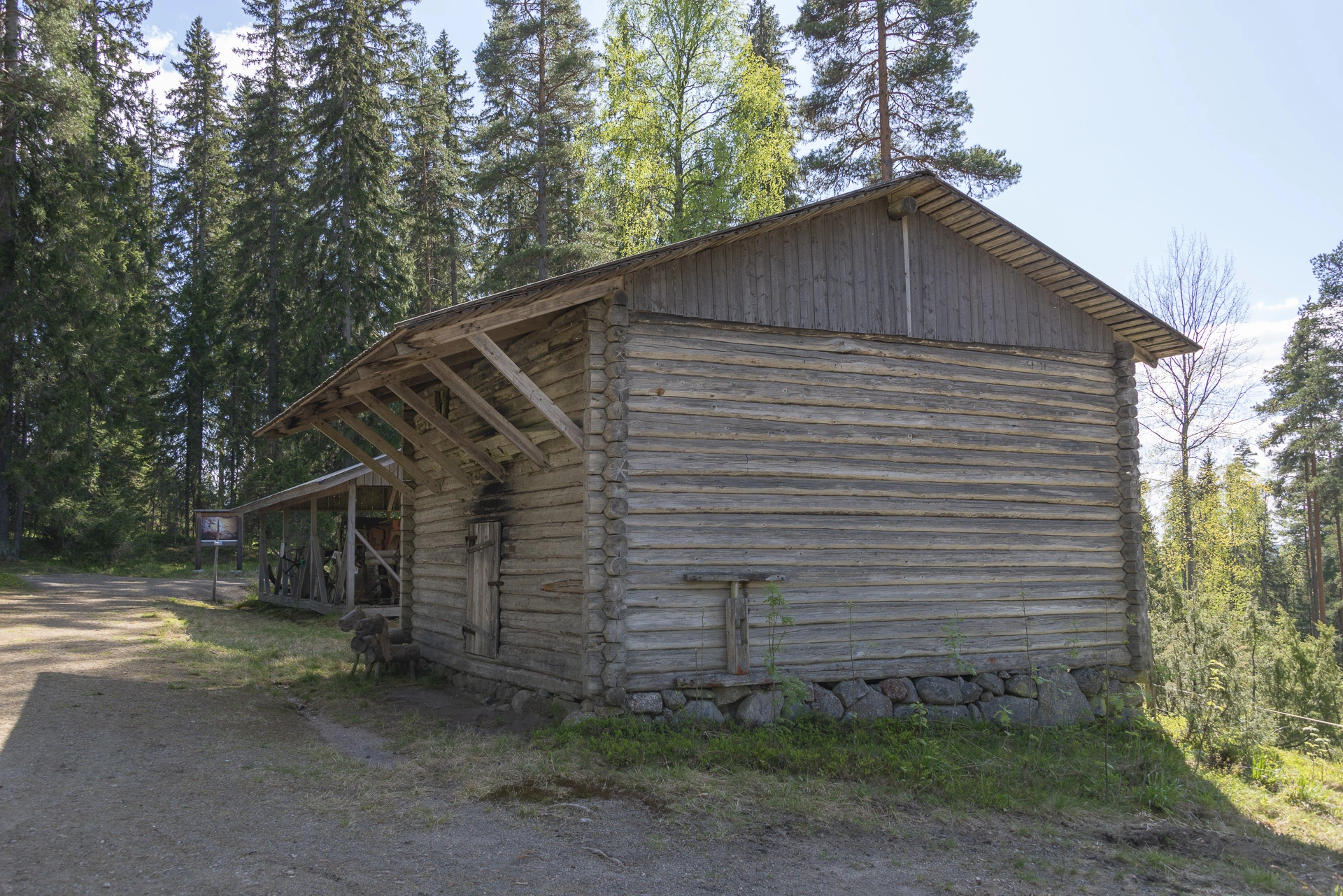
The Grain Drying Barn

The Grain Drying Barn
This building was constructed in 1900 at the “Talkooaho” farm in the village of “Sirkkamäki,” located in the southeastern part of Konnevesi. The riihi (drying barn) was used for drying and threshing grain. Agriculture began in Finland around the same time as in Central Europe — approximately 5300 BCE.
Grain was harvested with sickles and tied into sheaves, which were then dried on racks inside the riihi. The building was heated during this process. Warmth, dryness, and smoke helped preserve the grains and drove
away insects. Grains were separated from the sheaves by striking them against the wall and beating them with flails. The grain was then winnowed by tossing it into the air with a shovel to separate the chaff. Later, simple mechanical winnowing machines were used for this purpose.
Drying barns, smithies, and saunas were all prone to fire hazards. In the 1600s, a shared liability system existed, requiring all parish residents to contribute to compensations for fire damage. This often led to disagreements. In 1735, construction regulations were introduced to limit the size and type of buildings in order to prevent excessive liability. A list was created specifying the kinds and sizes of buildings that were permitted. Fire compensation eligibility was restricted according to this list. Nonetheless, disputes over compensation continued.
DEVELOPMENT OF AGRICULTURE
Agricultural work was heavy and required many hands. Gradually, various machines began to ease different stages of the work. The standard of living improved rapidly around the turn of the 19th and 20th centuries, as rural people began to earn income from selling timber, performing harvesting labor, and providing transportation. Another new source of income was the production and sale of butter. These earnings allowed farmers to purchase machinery to assist with various tasks.
At the same time, new methods based on scientific research were introduced. Knowledge began to spread through books and newspapers. Literacy became more common among the general population following the establishment of elementary schools, starting in the 1850s. By the early 20th century, a nationwide school network had been established.
Threshing machines developed and became common quickly during the 20th century. Initially, they were powered by windmills, simple farm engines, electricity, or tractors. Standalone threshing machines soon became obsolete, as grain harvesting and threshing have been carried out for decades now using combine harvesters. Although grain still needs to be dried, riihis (traditional drying barns) have long since fallen out of use. The widespread adoption of machinery in the 1950s and 1960s revolutionized agriculture, leading to a sharp reduction in the need for labor and a subsequent decline in the rural population. Today, one person can manage the crop-related tasks of even a fairly large farm.
Straw was used as bedding for animals and as filling for human mattresses.
Your feedback is important
Did you enjoy this information?

Theme
