Loading...
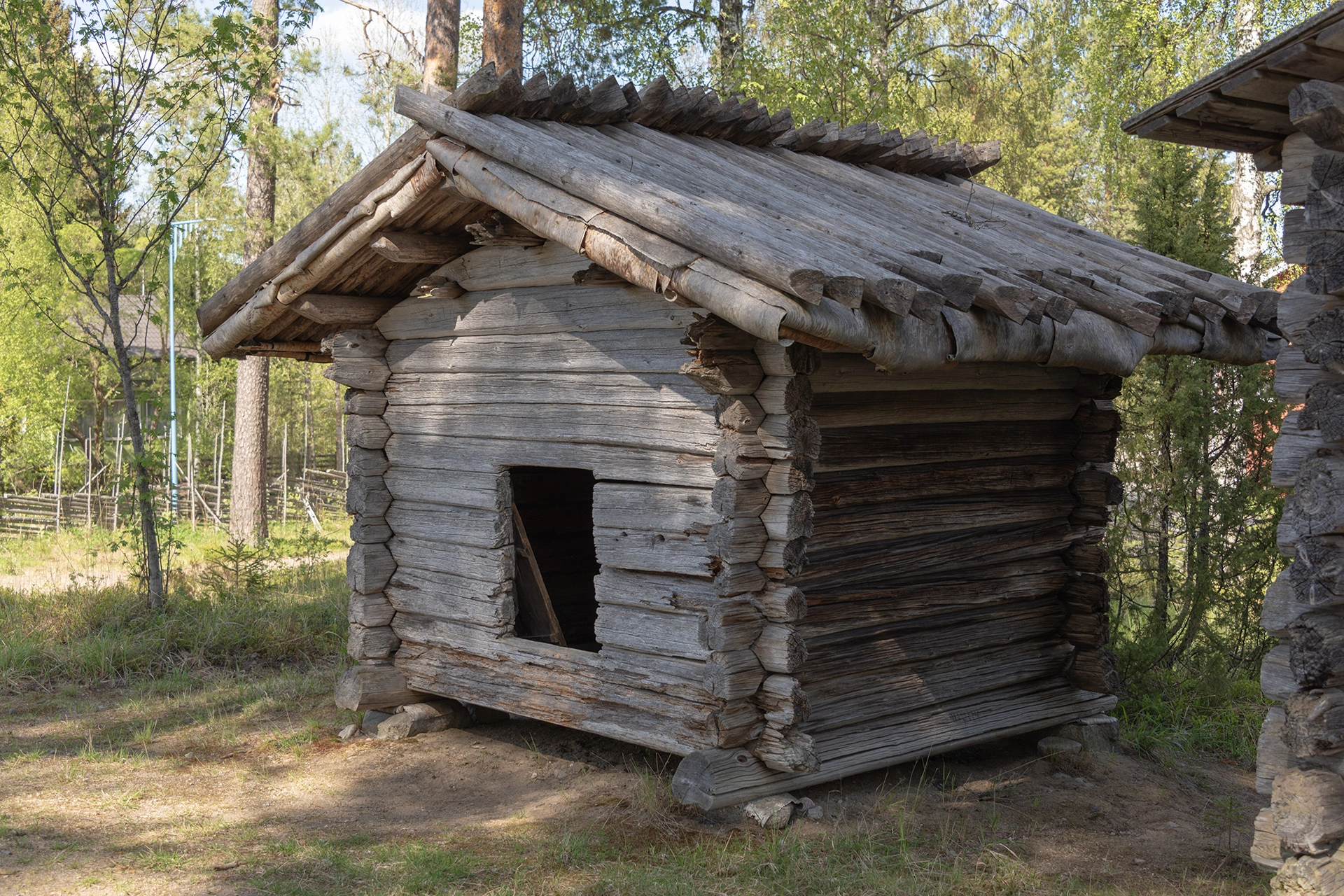
Small Storehouse "Puttola"

Small Storehouse "Puttola"
At the end of the row of storehouses in the museum, near the windmill, stands the oldest surviving building in the area. It was likely built as early as the late 1500s. It is believed that it was used by fishermen and hunters who came from the province of Häme to store their catch.
Before being moved to the museum, the storehouse was located in the village of Konnevesi, “Lahdenkylä,” south of the main building of the “Puttola” farm, along the road leading to the threshing barn (riihi). An article published in 1966 mentioned a date carved in the log walls of the storehouse: 1590. Anna Puttonen, who lived in the house, told that the storehouse had originally stood by Lake Liesvesi during the Russo-Swedish War from 1700 to 1721. From there, it was moved to the yard of the “Puttola” farm.
This war is known as the “Great Northern War.” It involved occupation, plundering, destruction, and forced deportations of people to Russia. The difficult times were worsened by an outbreak of the plague spreading from Estonia to Finland, causing great damage especially in Southern Finnish towns. After peace was restored, Finland returned to Swedish rule.
Decades later, in 1808–1809, a new war was fought, known as the “Finnish War.” According to oral tradition, this storehouse was used as an equipment depot for a local battalion commanded by Otto von Fieandt. The war was caused by a peace treaty between Russia and France, in which Napoleon gave Russia permission to conquer Finland from Sweden. Because of this, Finland became an autonomous Grand Duchy under Russia for about a hundred years.
Above the door of the building, two carved markings can be seen in the logs. From the date, the numbers “15 0” stand out. The numbers 1 and 5 were likely re-carved later, as they appear clearer than the following carving. Additionally, next to the door, there is a carving marked “Z1,” which might be interpreted as the number 81 or the letters ZI. On the lower part of the outer wall by the door, fragments of red ochre paint remain.
The museum replaced the storehouse’s roof in 2018. It was made in the original style using birch bark and carved poles laid over them. The roof type is called “malkakatto,” also known as a birch bark roof.
Your feedback is important
Did you enjoy this information?

Theme
