Loading...
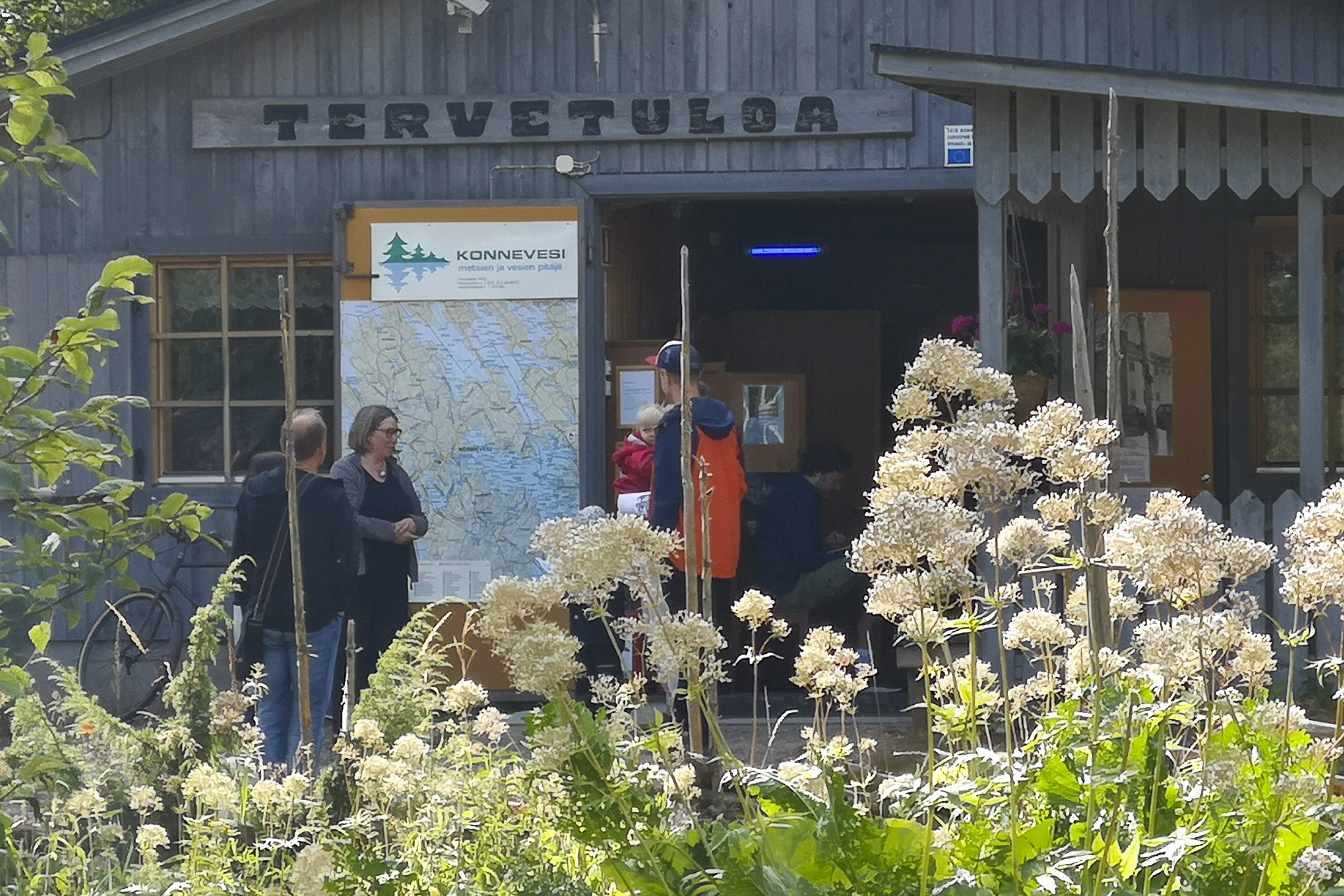
The Exhibition Building

The Exhibition Building
The exhibition building presents the most important phases of the municipality of Konnevesi, which gained independence in 1922. The exhibition illustrates, through examples, life in the 20th century, old professions, and events.
During opening hours, the exhibition building hosts a museum shop where visitors can purchase publications by the Konnevesi Local Heritage Association and postcards. The building also contains staff workspaces that are not open to the public.
Front Section of the Exhibition Building
Upon entering the exhibition space, the first thing you see is a partition wall about folk healing. It tells the story of the last folk healer of Konnevesi, Aapeli Lehmonen, who lived from 1894 to 1955. One of his principles was “Always do good, never do harm.” Folk healing had a very significant role, especially before Aapeli’s time.
Medical science was still quite undeveloped in the late 1800s, and only a few trained doctors lived far away. For ordinary people, doctors were hard to reach. Healers worked with knowledge passed down through generations, where medicinal plants played a large role. They also had psychological insight and understood they could not cure all diseases. They did not charge for their services. A Finnish-language book on this topic, Metelivettä ja leppätikkuja – kansanparantajia ja entisaikalaisia (“Noisy Water and Alder Sticks – Folk Healers and People of Old Times”), is available at the museum shop.
Next in the exhibition space is the workshop of boat master Matti Paalanen (1900–1999), complete with his tools and workpieces. The boat he donated to the museum is displayed in the museum area’s shelter (site 14). Paalanen made many wooden objects, but his clinker-built boats were famous and highly sought after. In a country covered with waterways, boats played a crucial role as means of transport and were essential for fishing. Drawings of boats can be found in rock paintings dating back 5000 years. Early clinker-built boats had planks fastened with tree roots and leather strips, later replaced by nails. Boat designs vary by region. The clinker-built wooden boat was added to UNESCO’s Intangible Cultural Heritage list in 2021.
Around the boat master’s workshop is the exhibition “Who am I, where do I come from? 10 testimonies from Konnevesi’s history.” In the showcase titled “Message from Ancestors” is the museum’s oldest object, a stone tool called the “Neiturintaipaleen tuura” after its find site. It was discovered in a riverside field in 1958 by Elvi Janhunen. This tool proves that people inhabited the Konnevesi area already 8000 years ago.
Stone tools were replaced by bronze ones around 1500 BCE. A thousand years later, iron and iron tools began to be made.
Slash-and-burn agriculture started in Finland already 2000 years before the common era. The method involved cutting and burning forest and sowing seeds on the ashes. After two years of cultivation, the area was left to regrow into forest. The practice was influenced by the type of forest. Rye was cultivated in coniferous forests, while barley, turnips, and flax were grown in mixed forests. Slash-and-burn agriculture was still common in the 1800s. As population grew, the rotation period shortened, causing yields to decrease and raising concerns about forest depletion. Wood was increasingly needed for other uses as well. Meanwhile, traditional field cultivation became more widespread.
Konnevesi received its first permanent settlers in the mid-1500s. Agriculture gradually developed into an important livelihood. A key advancement in agricultural productivity was the invention and spread of the cream separator in the late 1800s. Cream separated on farms was used in dairies to make butter.
Funds for new equipment were obtained from cream sales and forestry work. Farms acquired reversible plows, mowing machines, and expensive threshing machines. Logging shears, tools for forestry work, are the symbol of the forests and waters keeper and the coat of arms of Konnevesi. Timber sales, harvesting, transportation, and wood processing provide livelihood for many Konnevesi residents.
Konnevesi’s waterways have been natural transport routes for millennia for both local inhabitants and travelers. Settlement began growing near these waterways.
The nearest church, in Rautalampi, was reached by large church boats rowed by many rowers. Passenger steamship traffic, which started in 1909, accelerated the disappearance of church boats, and water traffic decreased as roads improved. Timber transportation by waterways continued until the late 1900s. In the early 20th century, bicycles began to change transportation conditions. Koivuranta company started bus traffic in 1923. It remains the oldest family-run bus company in Finland.
Electricity was a major innovation of the 20th century, gradually spreading and initially providing light, then later power for machines and devices.
Rear Section of the Exhibition Building
Local shoemaker Toivo Suuronen (born 1910) has had a replica of his workshop placed in the rear part of the exhibition space. On display are materials, tools, and equipment, including a large collection of shoe lasts. In Konnevesi, there are still people who fondly remember the exciting visits to the shoemaker’s shop during their childhood and receiving new shoes.
In the center of the rear section is a panel that explains, with text and images, how the 1920s was the decade of the birth of both the parish and the municipality. The church and the current town center were built during this time. Another panel tells about the 1950s, when the tractor appeared in the fields and the chainsaw in the forests. Machines and devices gradually appeared in all kinds of work and in everyday life. At the village dance pavilion "Silmutjoki," called "Varuskunta," people spent time and met friends. Next to the museum, in the former workers’ hall, dances and theatrical performances were held. In the now-demolished farmers’ association house, people watched movies and bus routes departed.
Old-time living is presented in two furnished rooms. The living room ("saliskammari") from the old building of the "Niittylä" house located in the village "Lahdenkylä" has been reconstructed in the museum as it was in the late 1920s. A radio receiver shows that public radio broadcasts had begun in Finland. An oil lamp lights the room.
Another alcove is furnished as a 1950s kitchen, complete with utensils. Finnish novelties of the time on display include a dish drying cabinet and a firewood box, both used in the "Niittylä" house. Electricity has arrived, lighting the room brightly and cleanly.
The exhibition building also houses a large collection of objects, including remains of ancient wooden boats (ruuhka), hunting equipment, locks made by the village blacksmith, various tools and skis, and a cradle for an infant. One specialty is a hand-operated lathe used for making wooden objects. A large number of smaller objects are also on display.
Your feedback is important
Did you enjoy this information?

Theme
