Loading...
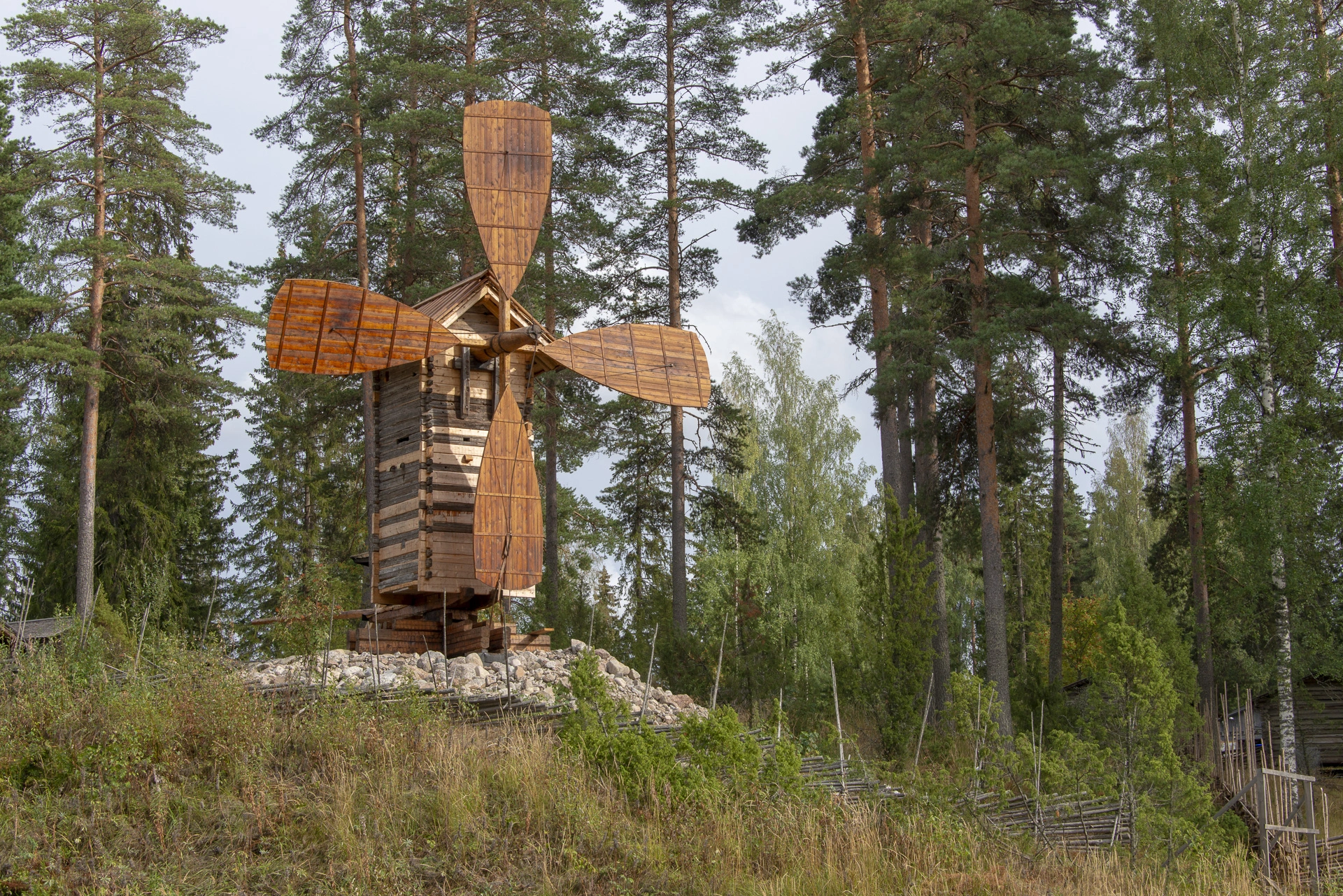
The Windmill

The Windmill
Mills have always been essential for grinding grain. Smaller amounts were ground by hand using rotating
stones. The first more efficient mills operated by water power, harnessed from local rapids. For some smaller mills, ponds’ outflow streams were dammed to store water. Suitable locations were few, and water shortages could prevent mill operation. Mills also caused various disputes among landowners.
The first windmills became common in the Konnevesi area in the late 1700s. They could practically be built in farmyards and operated independently. The windmill has two pairs of sails, which transfer power via a horizontal sail shaft inside the building to a large gear. The pegs on the gear’s rim transfer power to a vertically oriented shaft that turns the millstones. The gear at the top of this vertical shaft is called the “lantern.” The structures are almost entirely wooden and easy to repair when wear requires maintenance.
The mill is turned on its base to face the wind. To turn it, there is a tail pole at the back of the mill. On the side of the mill is a kind of plane used for preparing roofing materials. A strip of wood peeled off with the plane, called a “päre,” was a very common roofing material. Another use was for lighting, where a narrow wood strip was burned in a holder to provide light.
The Konnevesi Museum’s windmill was originally built in 1867 at the “Koipiniemi” farm on the eastern shore of Lake Pohjois-Konnevesi. It was moved in 1919 to the “Hannunaho” farm in the village of “Istunmäki” and brought to the museum in 1958. The windmill was thoroughly restored in 2020.
Your feedback is important
Did you enjoy this information?

Theme
