Loading...
House of Estates

House of Estates

Detta innehåll är inte tillgängligt på Swedish.
The House of the Estates was an ideologically significant building project. It was originally built for the meetings of the three non-noble estates of the Finnish Diet. The eventful early stages of the House of the Estates show that an important public building is often the result of lengthy negotiations and debate. A politically significant project may even require several architectural competitions.
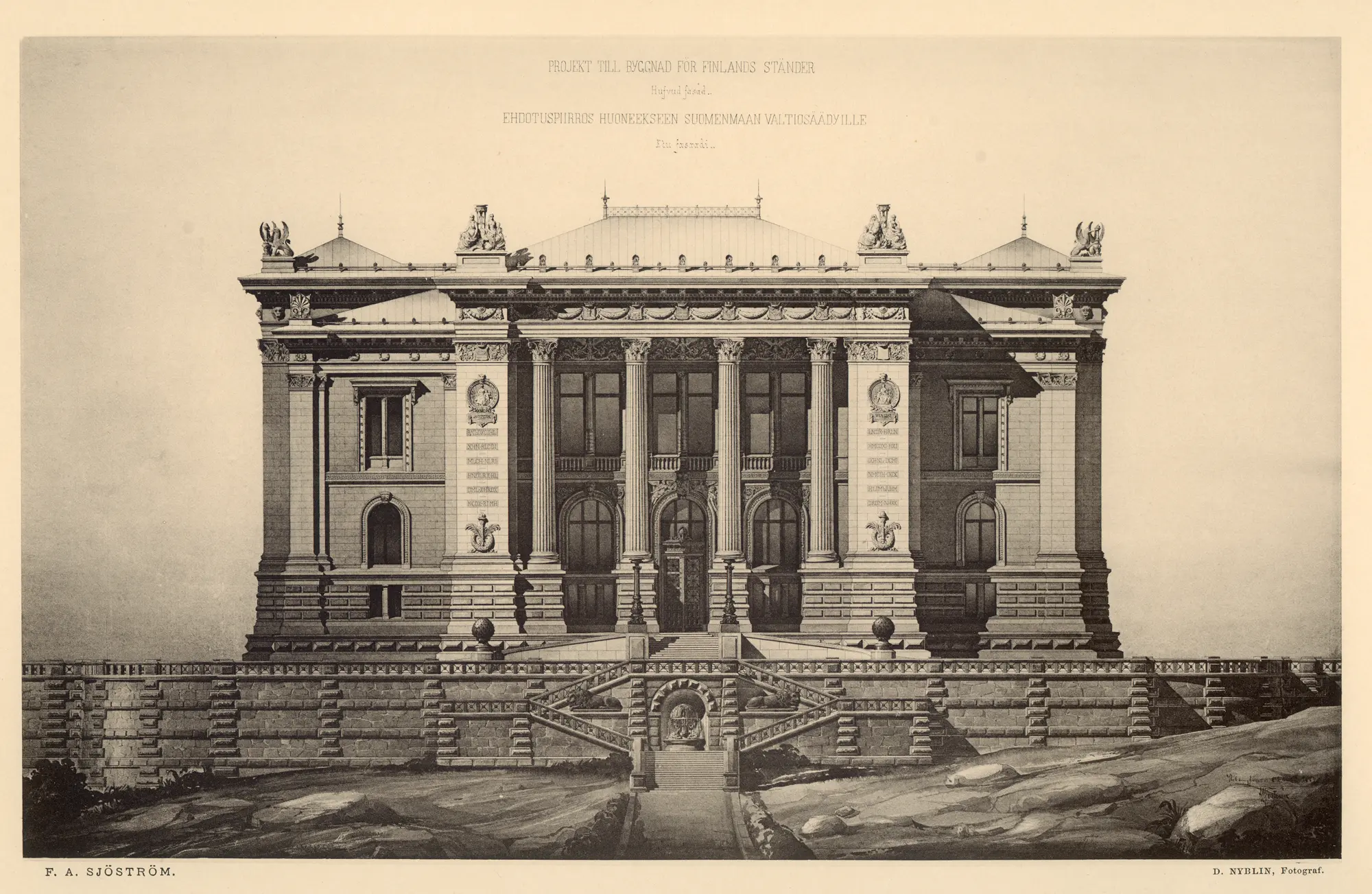
The competitions for the House of the Estates involved disputes over location and the death of a designer. The building is an example of an early competition in which a Finnish architect was chosen as the winner — though this came in the wake of tragic news: the original winner of the international competition, architect Frans Sjöström, died suddenly.
After Sjöström’s death, the location of the important building was fiercely debated, and a second competition was eventually held to determine the site. This was an invited competition, meaning that only designers and teams invited by the organiser were allowed to participate. The competition, held between four architects, was won by the Finnish architect Gustaf Nyström. He had been Sjöström’s student and assistant. Nyström’s proposal therefore includes features reminiscent of the plan his teacher had earlier prepared for Tähtitorninmäki.
The long political process behind the project proved worthwhile: with its rich details, the House of the Estates is one of Finland’s best-preserved public buildings from the late 19th century. It remains relevant today. During a successful renovation project, construction-era treasures were discovered in the intermediate floor structure — among them a knitted sock about 100 years old. The sock discovery inspired a large-scale knitting design competition, “The House of the Estates Sock 2025”.
Your feedback is important
Did you enjoy this information?
Tema
