Loading...
Helsinki University Extension

Helsinki University Extension

Detta innehåll är inte tillgängligt på Swedish.
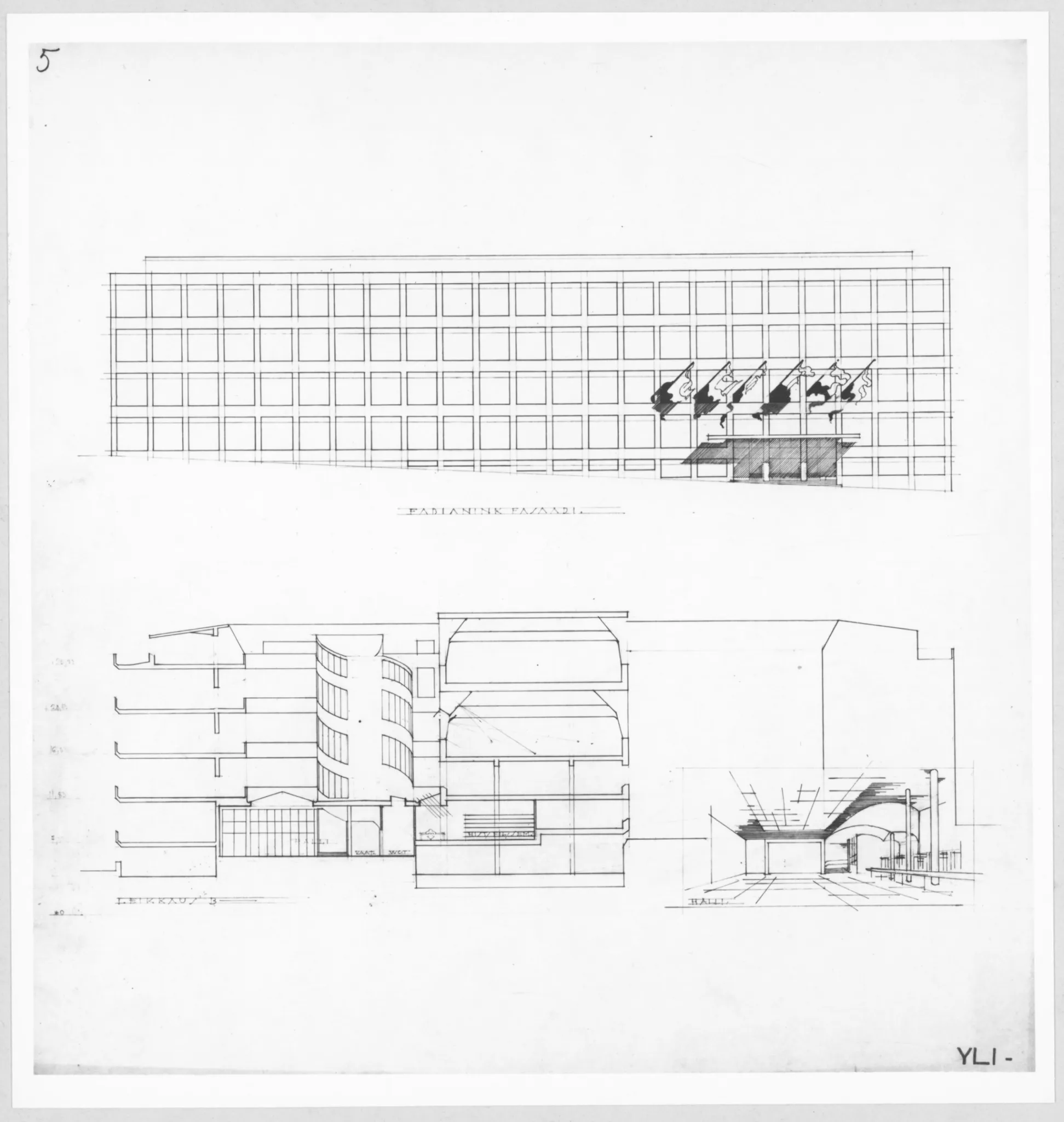
The extension of the University of Helsinki Main Building was a competition whose completed building, finished in 1937, many architects at the time considered an old-fashioned copy.
No winner was selected in the competition. Shared second place went to the classically oriented proposals by Jarl Eklund and Toivo Jäntti, and by J. S. Sirén, whose proposal was ultimately chosen for implementation. Their entries were submitted under the pseudonyms “Avla” and “Ad Claritatem”. The functionalist design “Hy-hu” by architecture student Kaj Englund was awarded third place.
The outcome of the competition was followed by heated debate. Supporters of the new functionalist style advocated an open block structure, while supporters of classicism defended closed perimeter blocks. Functionalists also argued that the extension should have been clearly distinguished from the older section designed by Carl Ludvig Engel. In their view, a new addition built as a stylistic imitation would weaken the value of the older building.
J. S. Sirén, however, designed the extension entirely in accordance with the university’s wishes. The competition brief had a strong influence on his proposal: it stipulated that Engel’s older building should serve as the foundational point of reference for the extension. The new wing therefore connects harmoniously with Engel’s Neoclassicism. Following Engel’s example, Sirén used columns and pillars in prestigious spaces, as well as spatial types derived from the Empire-style section. The seam between the old and new buildings was not clearly distinguished. The competition brief also defined the contested block structure, steering the project toward a closed perimeter block.
Architectural competitions involve both creativity and structure. Many factors — such as the competition brief — can limit the final outcome. In the competition for the extension, designers had to navigate between the university’s wishes and functionalism’s eagerness for reform.
Your feedback is important
Did you enjoy this information?
Tema
