Loading...
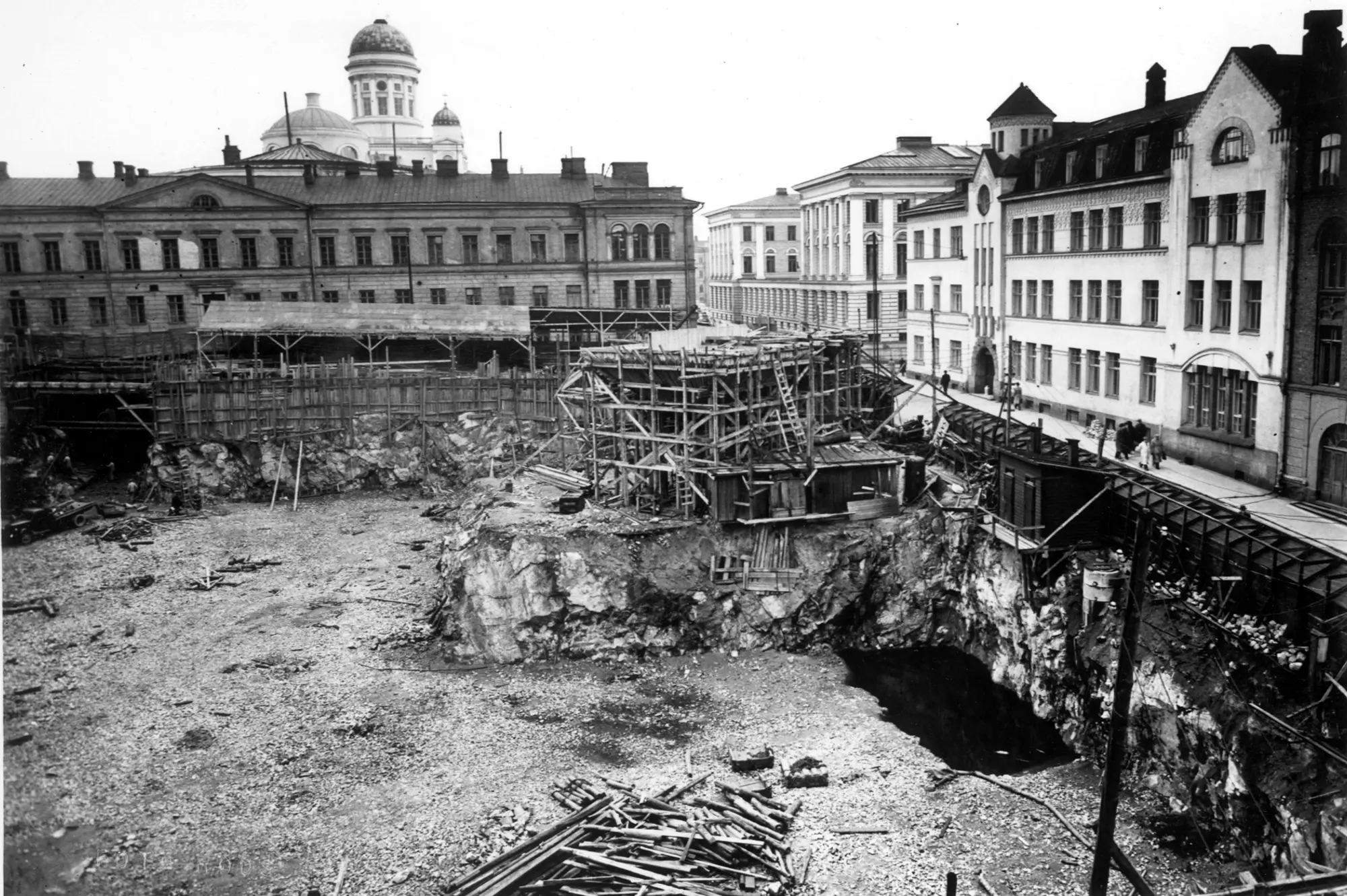
Porthania, Helsinki University Institute Building

Porthania, Helsinki University Institute Building

Detta innehåll är inte tillgängligt på Swedish.
By 1949, the time was ripe for new kinds of experimentation. That year, architect Aarne Ervi won the competition for the University of Helsinki institute building. Ervi’s Porthania introduced several innovations in construction — new materials, structures, and techniques, including precast concrete technology. Porthania was Finland’s first public building constructed almost entirely from prefabricated elements. These concrete element experiments also enabled a lighter building. Ervi designed Porthania’s entrance courtyard to be inviting and the building itself to be bright, in order to lighten the burden of students.
In the first phase of the competition, however, Ervi’s proposal did not convince the jury. The Porthania competition had many stages. The open competition was followed by a second-stage competition after the first phase ended with a shared first prize. The winners were Pentti Ahola and Iiro Tukkila’s proposal “Tiukallepa otti” and Keijo Petäjä’s proposal “Osteri”. Aarne Ervi’s “Studiosaurus” received only a purchase prize in the first competition, but in the second stage it surged ahead to become the winner — at the expense of the two earlier winning entries.
Only the proposals submitted in the first phase revealed the project’s problems more clearly. A follow-up competition was organised because the scale of the building programme had to be reconsidered. The spaces required by the original programme could have been fitted onto the site only by sacrificing the building’s internal qualities, such as suitable room dimensions and daylight. The openness of the plot and its green areas would also have had to be abandoned. For this reason, the designers of three proposals were invited to take part in a closed competition to rethink the building’s development. The pioneer of modern architecture, architect Alvar Aalto, was also brought in as an additional member of the jury. In the second-stage invited competition, Ervi’s “Studiosaurus” was unanimously selected as the winner.
The multi-stage Porthania competition is a textbook example of the long process involved in architectural competitions. From the day an architect submits a proposal, there is still a long road to the final building.
Your feedback is important
Did you enjoy this information?
Tema
