Loading...
Musiikkitalo Concert and Event Venue

Musiikkitalo Concert and Event Venue

Detta innehåll är inte tillgängligt på Swedish.
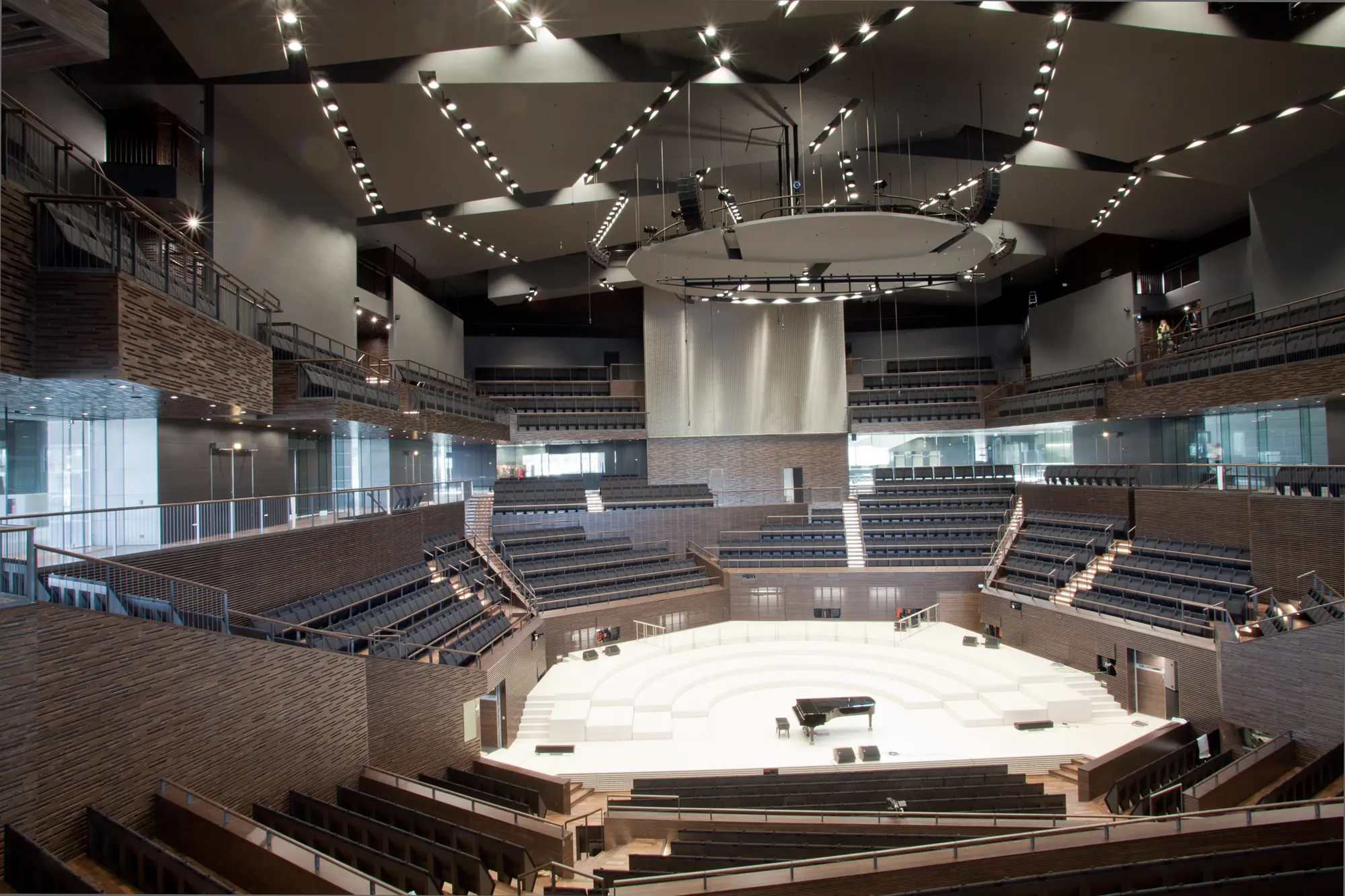
“Learn to play!” was the command of a famous acoustician when musicians in the Finnish Radio Symphony Orchestra complained about the sound of the newly opened Helsinki Music Centre. The orchestra had to learn to play in collaboration with a brand-new building. RSO conductor Hannu Lintu has suggested that every building resonates in its own way. In the design of the Music Centre, every material choice and technical solution centred on achieving the best possible sound quality. Acoustics also became a key factor in the architectural competition.
The two-stage architectural competition for the Music Centre was held in 1999–2000. It received 243 proposals, of which 68 advanced to the second stage. In the final stretch of the second phase, two entirely opposing proposals competed against one another. The proposal by Sarlotta Narjus and Antti-Matti Siikala was expressive and original — a landmark that stood out in the cityscape. Its challenger was the proposal “a mezza voce” by Ola Laiho, Mikko Pulkkinen, and Marko Kivistö, described as calm and restrained, “a precise block composition tied to the axes of its surroundings”.
The tight final contest between these opposing proposals also reflected differences of opinion regarding the development of the Kamppi–Töölönlahti area. The latter proposal emerged as the winner. “A mezza voce” means “in a half voice” — the winning proposal does not shout or thunder. Its point of departure is to unify and calm the general appearance of the area.
The soundscape of the Music Centre also compresses: it evens out loud sounds and gives space to what matters most — the music itself. The concert hall is built to support the performance of classical music. This means a particular kind of sound, in which reflections and reverberation play a central role. The soundscape of the Music Centre was designed by the world-famous acoustician Yasuhisa Toyota.
And indeed, the Music Centre has reason to play gently. Echoes of the past can still be heard on the site — memories of the VR warehouses, which were ordered to be demolished and finally burned down, almost fatefully, in May 2006. The warehouse area had been a centre for art, grassroots events, and civic organisations, and its demolition was opposed by citizens, politicians, and the Finnish Heritage Agency alike. The architectural competition for the Music Centre also influenced the fate of the buildings: none of the competition participants proposed preserving the warehouses, even though constructing the Music Centre did not require their demolition.
Your feedback is important
Did you enjoy this information?
Tema
