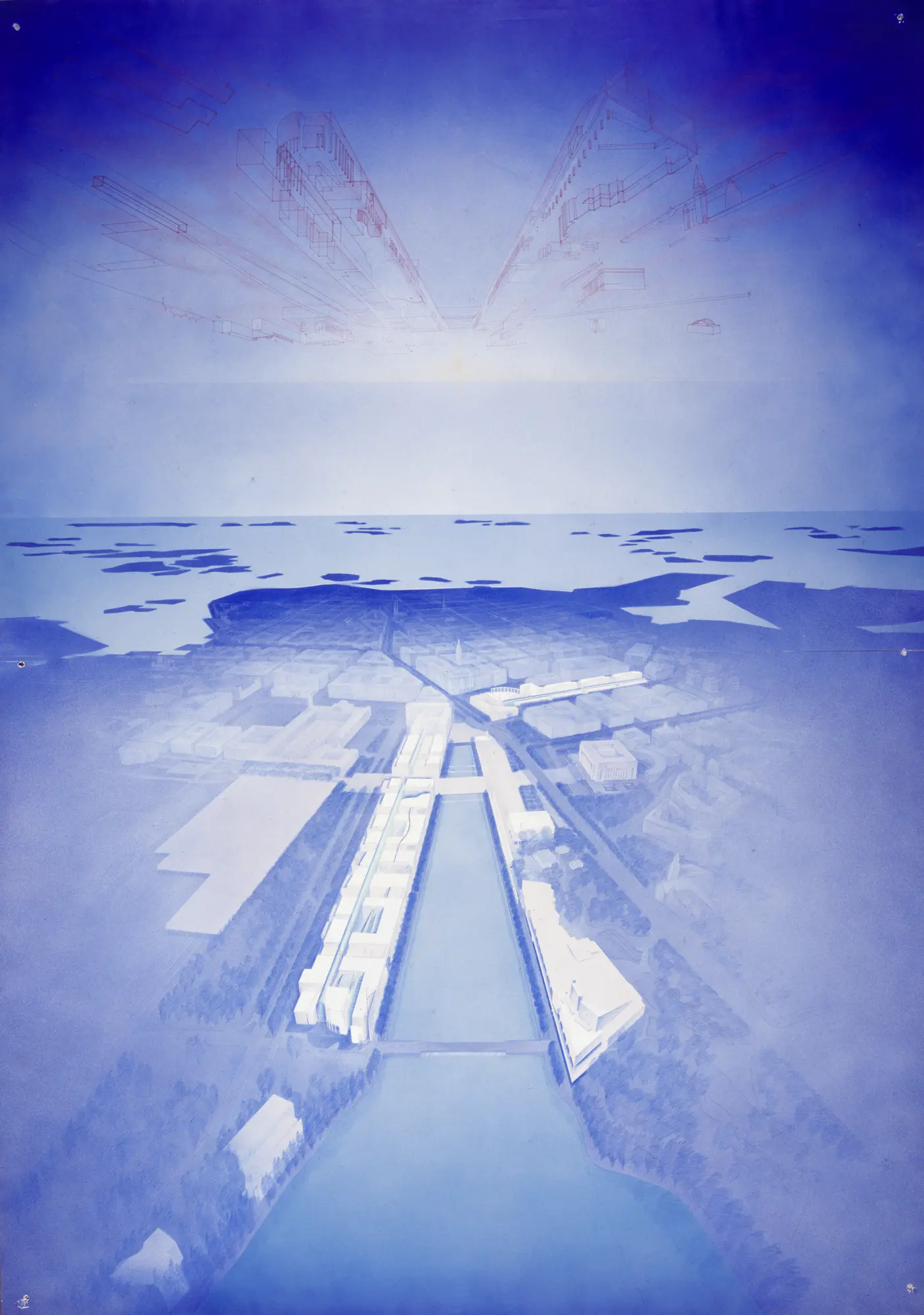
Töölönlahti Bay Area Competition


Töölönlahti Bay Area Competition

Detta innehåll är inte tillgängligt på Swedish.
The Kamppi–Töölönlahti area has been the subject of ever-new development plans for more than a century. Its history can be seen as a story of architectural competitions that remained at the level of dreaming. Proposals by famous designers followed one another for decades, without practical realisation.
In 1918, Eliel Saarinen prepared the first famous proposal for the area: the Pro Helsingfors town plan. This Greater Helsinki proposal was created in collaboration with Einar Sjöström and town planning architect Bertel Jung, but it was never realised. Oiva Kallio, in turn, won the competition for the planning of Etu-Töölö and the railway yard area in 1924. His plan, with its enclosed classical blocks and broad traffic routes — along with colleague Elsi Borg’s dynamic perspective drawings — also remained at the level of a dream. Yrjö Lindegren and Erik Kråkström’s 1954 city centre plan did have a concrete impact: it secured the preservation of the bay and green area, and plans to fill in Töölönlahti were abandoned.
Alvar Aalto also participated in the urban dreaming of famous designers. He developed his plan in several stages between 1959 and 1973, but it too never took concrete form, apart from Finlandia Hall. Töölönlahti, beside Kamppi, continued to develop as a free and vital in-between space.
The Kamppi–Töölönlahti ideas competition, held in 1985 and 1986, was one of the most important urban planning competitions of the decade. Its aim was to find an overall vision for the use of Kamppi, Töölönlahti, and the area between them — a valuable environment that had for decades been a creative wasteland of political disputes and inconclusive planning. Important questions in the competition included the preservation of park environments, the placement of future cultural buildings, and the possible densification of the city centre. There were stark differences of opinion, both among architectural schools of thought and among politicians, about what kinds of solutions were suitable for this central area.
The Kamppi–Töölönlahti ideas competition was exceptionally complex and produced highly varied proposals. It was an example of an ideas competition based on creative thinking, and in the end no single winner was chosen. First place was shared by three proposals. Among them was “Avoin sydän II” by Jan Söderlund, who would later become one of the designers of Sanomatalo. Also sharing first place was Arto Sipinen’s proposal “Pro Finlandia”, whose pseudonym recalls Eliel Saarinen’s famous “Pro Helsingfors” proposal for the area. Ilmo Valjakka and Kari Mökkälä were also awarded shared first place. Their pseudonym, “Kaunis uneksija” — “Beautiful Dreamer” — also captures the area’s hopeless planning history. True to its name, “Beautiful Dreamer” remained dreaming its urban dreams, as the Kamppi–Töölönlahti ideas competition also failed to lead to realisation. The partial master plan proposal produced as a result of the competition was buried by the recession, joining the long line of other unrealised ideas for the area. Art historian Riitta Nikula has called Töölönlahti “a cemetery of heroic urban plans”.
The difficulties of unrealised urban planning were eventually resolved through incrementalism — a process in which decision-making proceeds step by step. Beginning with the Kiasma competition in 1993, planning in the area advanced as interested parties with the necessary funding emerged. Kiasma, Sanomatalo, the Music Centre, Oodi, and the park areas were realised as point-by-point interventions without an overall plan. Each decision gradually shaped the character of the area.
The delay in planning Kamppi–Töölönlahti opened up opportunities for another kind of use: a creative and flourishing local culture. In the Kamppi–Töölönlahti ideas competition, the area’s earlier building stock and local culture seemed almost invisible. The whole area appeared as a blank canvas on which the shameless heroes of urban planning could leave their mark. Despite the designers’ attitudes, it was precisely citizen activism and local activity that continued and developed in the area. Distinctive art activity flourished in Kansalaistori Square and the surrounding green areas, and later both an art garden and an environmental art park were created there.
A lively civic movement also began to develop around the former freight warehouses of the railway company VR. In front of Central Library Oodi, you can find the artwork Massa embedded in the street paving. It is a memorial inscription to the VR freight warehouses, which burned down around May Day in 2006 after having been sentenced to demolition. The work is a living reminder of the local culture made possible by delayed urban planning.